
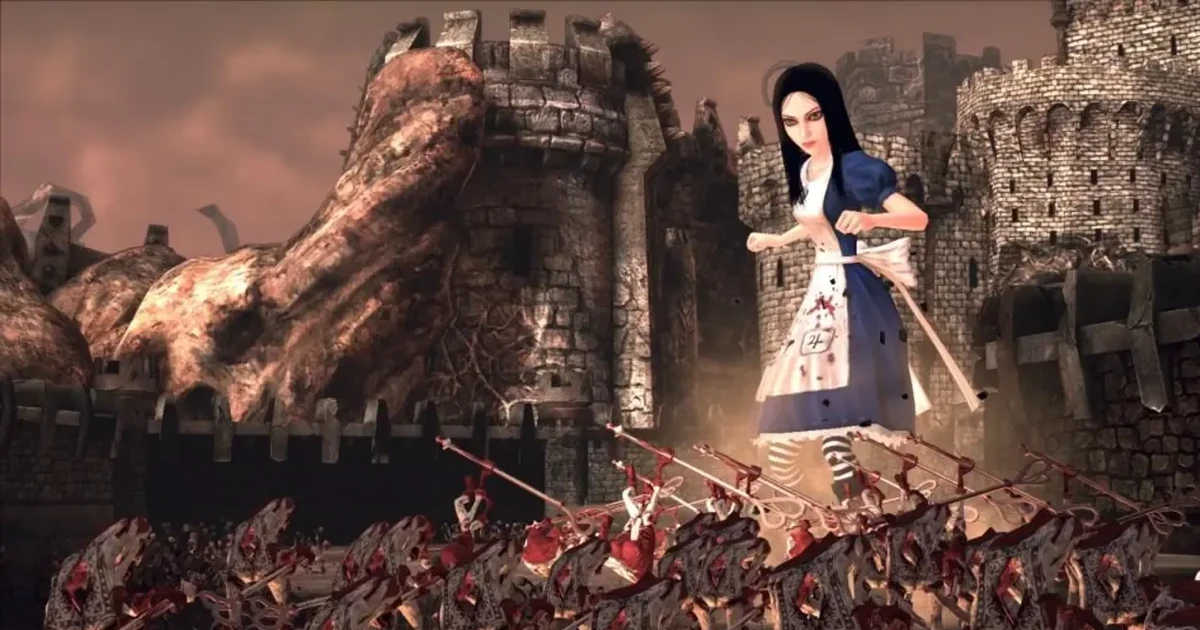
GAME INFORMATION
Game Title: Alice: Madness Returns
Platform Played:PC
Available Platforms:PC, Xbox, PlayStation 3, Xbox 360
Media Type: Digital
Developer:Spicy Horse
Publisher:Electronic Arts
Genre:Third-person action adventure platformer
Release Year:2011
PLAY ENVIRONMENT
Playtime:18 hours
Completion Status:Completed
Difficulty:Normal
Graphics Mode:Default
Playthrough Type:Standard playthrough
Game Version:Steam Release
Controller Used:DualShock
Display Environment:1080p Monitor
QUICK VERDICT
Alice: Madness Returns is one of the most visually memorable action platformers of its generation. Its version of Wonderland is beautiful, disturbing, imaginative, and full of strange detail. Alice herself controls smoothly, the combat is simple but satisfying, and the art direction carries the game with real confidence.
However, the game is far too long for the amount of ideas it has. The platforming is solid, but it repeats itself too often. The collectibles feel padded, the story is spaced too thinly, and many chapters feel like they continue long after they have made their point.
It is still worth playing, especially if you love dark fantasy, surreal worlds, gothic design, or unusual interpretations of classic stories. But it is also a game that would have been much stronger with tighter pacing and less repetition.

PROS & CONS
pros
- Beautiful and unforgettable art direction
- Excellent character design for Alice
- Smooth movement, jumping, gliding, and dodging
- Creative world themes and environmental detail
- Simple but enjoyable combat tools
cons
- Far too long for its gameplay variety
- Some audio cues and subtitle support are inconsistent
- Collectibles often feel pointless
STORY & NARRATIVE
Alice: Madness Returns begins in a grey and miserable version of the real world, where Alice Liddell is speaking with a therapist and trying to live with the trauma of her past. From the start, the game makes one thing clear. This is not a cheerful fairy tale. This is a journey through a damaged mind.
The story follows Alice as she returns to Wonderland, not as an escape in the simple sense, but as a way to understand what happened to her and why her memories remain so broken. Wonderland becomes a reflection of her internal state. It is beautiful, but corrupted. Magical, but hostile. Childlike, but deeply violent underneath the surface.
This is one of the strongest ideas in the game. Alice: Madness Returns understands that Wonderland should not only be strange. It should feel unstable. It should feel like a dream that can turn into a nightmare without warning. The game uses that idea well, especially in its visual design and atmosphere.
The problem is that the actual plot does not always carry the same strength. The opening is interesting, and there are several moments that suggest a darker mystery beneath everything. But these moments are spaced too far apart. For long stretches, the player is simply moving through large areas, fighting enemies, collecting items, and waiting for the next meaningful piece of story to appear.
Because of this, the narrative can lose urgency. The emotional core is strong in concept, but the pacing weakens its impact. There is a mystery at the centre of the game, but the game does not always make that mystery feel immediate. By the time the ending arrives, it has some weight, but it also feels like the story could have been sharper, clearer, and more focused.
The best storytelling in Alice: Madness Returns is not always in the dialogue or plot structure. It is in the world itself. It is in the broken machinery, the twisted dolls, the floating platforms, the ruined memories, and the contrast between beauty and damage. As a visual and symbolic journey, the game succeeds. As a tightly told narrative, it is more uneven.
GAMEPLAY & SYSTEMS
At its core, Alice: Madness Returns is a third-person action platformer. Most of the game is spent moving through large linear levels, jumping across platforms, fighting groups of enemies, solving light environmental puzzles, and collecting items.
The strongest part of the gameplay is Alice herself. She feels good to control almost immediately. Her triple jump gives the platforming a light and graceful rhythm, and her glide adds a soft, almost angelic feeling to movement. There is a nice contrast between the harshness of the world and the elegance of Alice’s movement.
Her dodge is also excellent. Instead of a normal roll or dash, Alice dissolves into a cloud of butterflies. It looks beautiful, but it is also practical. It makes combat feel responsive and stylish without becoming overly complicated.
The weapons are simple, clear, and easy to understand. The Vorpal Blade is fast and reliable. The Hobby Horse is heavier and better for breaking guards. The Pepper Grinder gives Alice a ranged option. Each weapon has a purpose, and switching between them feels natural. The game avoids overwhelming the player with too many systems, which helps the combat remain approachable.
There is a comfortable balance here. Alice is not a deep character action game in the style of Devil May Cry or Bayonetta, but it also is not mindless. It sits somewhere between simple action and light combo-based combat. That works well for the type of game it is trying to be.
The issue is not that the mechanics are bad. The issue is that the game does not develop them enough across its full length.
The platforming is solid, but there is a lot of it. Alice jumps between floating objects, moving platforms, invisible paths, air vents, and themed obstacles. These sections are often visually different, but mechanically they can feel similar. Whether Alice is jumping across mah-jongg tiles, cages, mushrooms, jellyfish, or broken ruins, the action is often the same. Jump, glide, land, repeat.
This would be less of a problem in a shorter game. But Alice: Madness Returns is long, and many chapters feel much larger than they need to be. The first time you cross a surreal landscape full of impossible platforms, it feels magical. The second time, it is still enjoyable. The third or fourth time, the repetition becomes harder to ignore.
The game also includes a large number of collectibles. Some of these add pieces of memory or extra flavour, but many feel like padding. Breaking objects for teeth, searching side paths for bottles, and looking for hidden pig snouts can give completionists something to do, but the rewards rarely feel meaningful enough to justify the amount of searching.
The upgrade system is useful, because teeth allow Alice to improve her weapons. But outside of that, the collectible design often feels like it belongs to an older era of 3D platformers. There is a certain charm to that, but it also makes the game feel dated.
Alice: Madness Returns often feels like a brilliant eight-hour game stretched into a fifteen-hour one. The controls are good. The combat is fine. The platforming works. But the game repeats these elements for too long without enough new ideas to keep the pace alive.
WORLD DESIGN
Wonderland is the main reason to play Alice: Madness Returns.
The world design is imaginative, strange, and full of personality. Every chapter has its own identity, and the game constantly finds new visual ways to express Alice’s fractured mind. There are areas filled with bright colours and impossible skies, then others filled with grime, blood, machinery, and decay.
The world often feels like a memory that has been rebuilt incorrectly. Familiar fairy tale ideas appear, but they are twisted into something more violent and unstable. There is beauty everywhere, but it is rarely peaceful. Even the most colourful areas have something wrong beneath them.
This is where the game’s old-school platforming structure works best. The levels feel like strange obstacle courses inside a dream. Floating platforms, hidden paths, oversized objects, and surreal architecture all fit naturally into the idea of Wonderland. The game does not need to explain why anything is floating in the sky or why the landscape changes so suddenly. It is Wonderland. The logic is emotional rather than realistic.
However, the level design does not always match the quality of the world design. The environments look different, but the structure of play is often similar. Move forward, clear platforming section, fight enemies, search for collectibles, repeat. The game’s spaces are beautiful to look at, but not always interesting to move through for long periods.
Still, the atmosphere is strong enough that even weaker sections have visual value. There are moments where you stop moving just to look at the scenery. Castles made of cards, vast skies, underwater spaces, doll-like horrors, and industrial nightmares all leave an impression.
As a world, Wonderland is exceptional. As a sequence of levels, it is more uneven.
VISUAL DESIGN
The visual design is easily the strongest part of Alice: Madness Returns.
This game has a clear artistic identity. It knows exactly what it wants to be: elegant, gothic, surreal, violent, sad, and beautiful. Very few games manage to create a world this strange while still feeling coherent.
The use of colour is excellent. Wonderland is not just dark and grey. It can be bright, rich, and magical, which makes the horror elements stand out even more. The game understands contrast. Beauty and ugliness are constantly placed beside each other. That contrast gives the world its power.
Alice herself is also wonderfully designed. Her appearance is simple but iconic. Her dark hair, sharp eyes, and changing dresses make her feel connected to each world she enters while still remaining clearly herself. The dresses are one of the game’s best visual details, because they turn Alice into part of the environment without losing her identity.
Her animations also add to the sense of elegance. The way she jumps, glides, dodges, and attacks gives her a graceful presence. She feels light, but not weak. Fragile, but not helpless. That balance is important, because the game is about trauma, survival, and reclaiming control.
Even years later, Alice: Madness Returns remains visually memorable. It may not be technically modern anymore, but strong art direction ages better than raw graphical power. This is a game carried by style, mood, and imagination.
SOUND & MUSIC
The sound design supports the atmosphere well. The music often feels eerie and dreamlike, helping Wonderland feel unstable and haunted. It does not always push itself to the front, but it works quietly in the background to build mood.
Combat music and sound cues often signal when enemies or danger are nearby. This can be useful, although combat does not depend entirely on audio. Most enemies are clearly introduced visually, and the player usually has enough time to react.
There are some issues with audio feedback. Hidden pig snouts are apparently signalled by an oinking sound, but this cue can be easy to miss or difficult to hear. For players who rely less on audio, this makes some hidden collectibles harder to find.
Dialogue subtitles are included, which is good, but there are a small number of moments where subtitles appear to be missing. These moments are not frequent, but they are still worth mentioning.
Overall, the sound and music are effective, especially for atmosphere. They are not as unforgettable as the visual design, but they support the world well.
PERFORMANCE
The PC version runs well overall, though the experience may depend on the setup being used. The game is older now, so modern systems should generally have little trouble running it, but older PC releases can sometimes require small adjustments depending on hardware, resolution, or controller support.
In normal play, performance does not get in the way of the experience. The platforming needs stable control and readable movement, and for the most part, Alice: Madness Returns delivers that. The camera can occasionally be awkward during platforming or combat, but it is not a constant problem.
The game’s age is more noticeable in its structure than in its performance. It feels older because of its pacing, collectibles, and level design habits, not because it is visually weak or technically broken.
DIFFICULTY
Difficulty Rating
3 / 10
Alice: Madness Returns is not an especially difficult game, but it does ask for patience. The platforming is usually fair, and Alice’s triple jump and glide give the player plenty of control in the air. Most missed jumps feel like small mistakes rather than unfair design.
Combat is also manageable. Enemies have clear patterns, and the weapon system is easy to understand. The game becomes harder when multiple enemy types appear at once, especially when ranged pressure, shields, and heavier enemies are combined. Still, the difficulty rarely becomes extreme.
The real challenge is endurance. The game is long, and because many sections repeat similar ideas, staying engaged can become harder than the actual combat or platforming. For some players, the length will be more tiring than the difficulty.
REPLAY VALUE
Replay value depends heavily on the type of player.
If you love collecting everything, upgrading weapons fully, finding hidden bottles, and exploring every side path, there is a lot to return to. The game has many collectibles and secrets spread across its chapters.
However, for players who mainly care about story, atmosphere, and the main experience, replay value is lower. The game is already quite long on a first playthrough, and the repeated platforming makes a second run feel less tempting.
The strongest reason to replay Alice: Madness Returns is the world itself. Wonderland is beautiful enough that some players may want to revisit it simply for the atmosphere. But mechanically, there is not enough variety to make replaying feel essential.
RECOMMENDED FOR
Recommended for:
- Players who enjoy dark fantasy and gothic worlds
- Fans of Alice in Wonderland reinterpretations
- Players interested in older cult classics
- Fans of surreal, dreamlike game worlds
Not recommended for:
- Players who dislike repetitive platforming
- Players who need fast pacing
- People who want a deep combat system
PERSONAL EXPERIENCE
I have a soft spot for Alice in Wonderland, especially darker interpretations of it. The idea of being lost inside a strange, symbolic, almost hallucinogenic world has always interested me. Because of that, Alice: Madness Returns was a game I knew I would eventually play.
At first, it gave me exactly what I wanted. The shift from the grey real world into Wonderland was immediately striking. The game understands the appeal of a beautiful nightmare. It is colourful, but sad. Magical, but broken. There were many times where I simply admired the world and the amount of creativity behind it.
Alice herself was another highlight. I loved how natural she felt to control. The jumping, gliding, dodging, and weapon switching all became comfortable very quickly. There is something graceful about the way she moves through such a hostile world. She feels elegant without feeling weak.
But after several hours, I started to feel the game’s length. The same basic rhythm kept repeating. Platforming section, combat section, collectible search, another platforming section. The visuals kept changing, but the structure often stayed the same.
That is where my feelings became mixed. I loved the artistic side of the game, but I did not always love playing through every part of it. I wanted to see the next world, the next dress, the next strange piece of imagery. But I did not always want to complete another long sequence of similar jumps and side paths to get there.
The game’s best moments are genuinely memorable. The later chapters especially show how powerful its art direction can be. But the journey would have been stronger if it had been more focused. There is an excellent game here, but it is buried under too much repetition.
FINAL VERDICT
Alice: Madness Returns is a beautiful, strange, and deeply atmospheric action platformer. Its version of Wonderland is one of the most memorable dark fantasy worlds in games, filled with rich colours, disturbing imagery, and unforgettable visual ideas. Alice herself is stylish, graceful, and satisfying to control, and the basic combat and platforming systems are easy to enjoy.
But the game is also too long. Its chapters stretch beyond their natural limit, and the platforming does not evolve enough to support the full runtime. The collectibles often feel like padding, and the story, while interesting in concept, is spread too thin across the journey.
This is a game with incredible art direction and uneven pacing. It is worth playing for its world, atmosphere, and unique interpretation of Alice, but it is also hard not to imagine a stronger version of the same game. A shorter, tighter Alice: Madness Returns could have been something truly special.
As it stands, it remains a cult classic worth experiencing, especially for players who value mood, style, and imagination. It is not perfect, but it is unforgettable.