
GAME INFORMATION
Game Title: Akira Psycho Ball
Platform Played: Playstation 2
Available Platforms:Playstation 2
Media Type: Physical Disc
Developer:Cavia
Publisher:Infogrames / Atari
Genre:Digital Pinball
Release Year: 2002
PLAY ENVIRONMENT
Playtime:8 hours
Completion Status: Completed
Difficulty:Default
Graphics Mode: Default
Playthrough Type:Blind playthrough
Game Version: Original Release
Controller Used:DualShock 2
Display Environment: CRT TV
QUICK VERDICT
Akira Psycho Ball is one of the strangest and most interesting anime game adaptations on the PlayStation 2. Instead of turning Akira into an action game, racing game, or cinematic adventure, it reimagines the film through digital pinball tables.
That idea sounds unusual at first, and maybe even slightly confusing. However, the more time I spent with it, the more I respected what the game was trying to do. This is not just a standard pinball game with Akira artwork placed over the top. It uses scenes, characters, visual themes, anime clips, and table transformations to turn key moments from the film into interactive pinball sequences.
It is not perfect. The physics feel dated, the ball can feel too heavy, and story progression can become repetitive and frustrating. However, its creativity, atmosphere, and surprisingly entertaining versus mode make it much better than its premise might suggest.
Akira Psycho Ball is not a hidden masterpiece, but it is a fascinating and enjoyable piece of PlayStation 2 history. For fans of Akira, digital pinball, cyberpunk anime, or unusual licensed games, it is worth experiencing.

PROS & CONS
pros
- Creative and unusual adaptation of Akira.
- Transforming playfields make tables feel more dynamic.
- Objectives help connect the pinball gameplay to the film.
- Simple, responsive, easy-to-understand controls.
- Strong use of anime clips, voice samples, music, and visual references.
cons
- Ball physics feel too heavy and difficult to control.
- Story mode becomes repetitive over time.
- Objectives often rely on repeatedly hitting specific targets.
- Limited balls and harsh restarts can make progression frustrating.
- Some table layouts feel sparse or underused.
STORY & NARRATIVE
Adapting Akira into a video game is not an easy task. The film is known for its powerful imagery, cyberpunk atmosphere, political tension, psychic violence, and emotional intensity. Many games based on anime choose a more obvious direction, such as fighting, racing, or action adventure. Akira Psycho Ball does something very different.
Rather than letting players control Kaneda, Tetsuo, or other characters directly, the game presents the story through a sequence of pinball tables. Each table represents a major section or visual idea from the film. These include the motorcycle chase, laboratory scenes, psychic experiments, and the final confrontation.
This structure is unusual, but it has a certain charm. The player progresses by completing missions within each table. These missions may involve hitting certain targets, collecting items, activating ramps, or triggering special events. When objectives are completed, the game often shows clips from the original anime, using them as short transitions between stages.
The storytelling is simple, and players unfamiliar with Akira may not fully understand every event. The game does not replace the film, and it does not explain the story in great depth. Instead, it works more like an interactive tribute. It assumes that the player either knows the source material already or is willing to experience the game as a series of visual and thematic references.
For fans of the film, this approach can be quite enjoyable. Seeing iconic scenes represented through pinball objectives gives the game a unique personality. It does not always succeed perfectly, but it feels sincere. The developers clearly tried to connect the mechanics to the identity of Akira, rather than simply using the licence as decoration.
In that sense, Akira Psycho Ball is more interesting than many straightforward anime adaptations. It may not tell the story with emotional depth, but it captures fragments of the film’s energy, chaos, and style.
GAMEPLAY & SYSTEMS
At its foundation, Akira Psycho Ball is a digital pinball game. The player controls the flippers, launches the ball, aims for ramps and targets, builds score, and tries to keep the ball in play for as long as possible.
The basic controls are easy to understand. The DualShock 2 works well for this style of game, and flipper response is generally solid. There is a simple satisfaction in keeping the ball alive, learning angles, and slowly understanding how each table works.
Where the game becomes more interesting is in its mission structure. Instead of only asking the player to chase a high score, each table has objectives tied to progression. The player may need to activate certain areas, hit specific switches, collect story items, or trigger special sequences such as psychic battles or multi-ball events.
These objectives give the game a stronger sense of direction than ordinary pinball. There is always a small goal to focus on, which makes story mode feel more structured. The game is not only asking, “How long can you survive?” It is also asking, “Can you understand the table well enough to move the scene forward?”
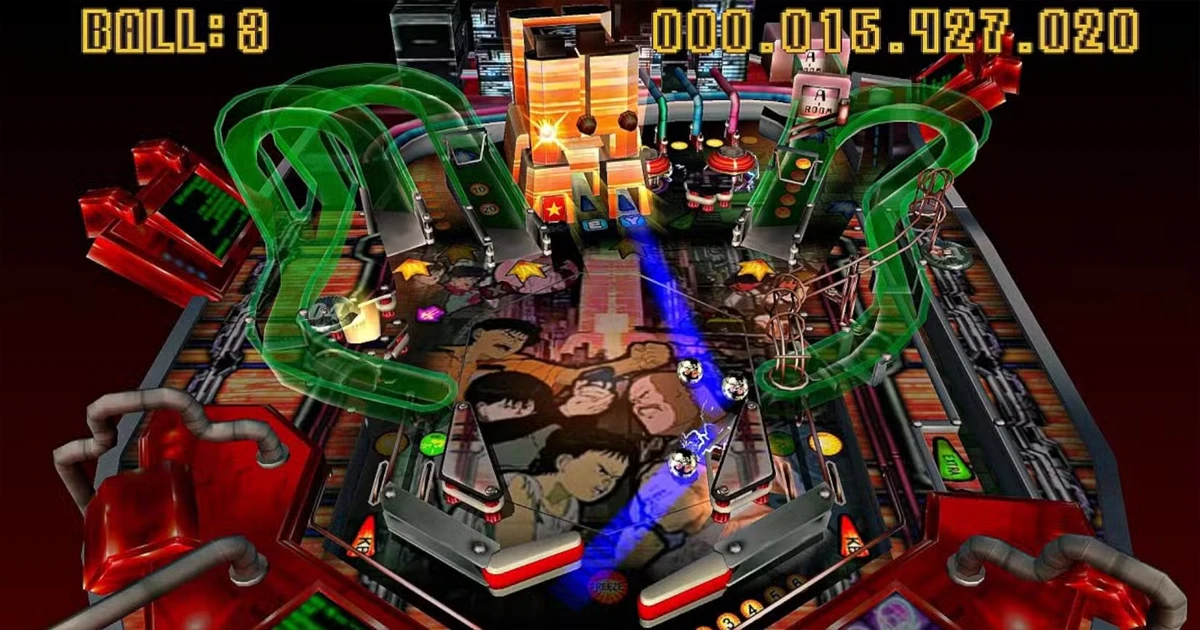
The best moments happen when the table changes in response to the player’s actions. Ramps may open, new areas may appear, visual elements may shift, and the table may begin to reflect a new stage of the story. These transformations are one of the game’s strongest ideas. They show how digital pinball can do things that a physical table cannot.
However, the gameplay also has clear limitations. The physics system is the main issue. The ball feels unusually heavy, and the downward pull is strong. This means that the ball often drops faster than expected, and the player has less time to react. Some shots do not carry the momentum they seem like they should, making certain objectives harder to complete.
This creates an awkward balance. The game often demands precision, but the physics do not always feel precise enough. When a failure happens because of poor timing or a mistake, it feels fair. When the ball suddenly drops in a way that feels difficult to control, frustration builds quickly.
The mission structure can also become repetitive. Many objectives rely on repeatedly hitting certain targets, and if the player loses all balls before completing the task, progress can feel harsh. This is especially noticeable in story mode, where repeated attempts can make the experience feel more exhausting than exciting.
Even so, the core loop remains enjoyable. There is still pleasure in learning table routes, chasing higher scores, triggering events, and improving with each attempt. The game has problems, but it also has a simple arcade quality that keeps it engaging.
WORLD DESIGN
Akira Psycho Ball features four main tables, each based on important parts of the film. These tables include the bike chase, the laboratory, the A-Room chaos, and the final stadium confrontation.
Each table has its own visual identity and set of objectives. The bike chase table captures movement and speed. The laboratory table leans more into experimentation and psychic imagery. Later tables become stranger and more chaotic, reflecting the increasing instability of the story.
The table transformations are the most memorable part of the design. As objectives are completed, the playfield can shift in ways that make the table feel active and reactive. This gives the player a sense of moving through the story, even though the core gameplay remains pinball.
This is where the game feels most ambitious. A normal pinball table is usually fixed, but Akira Psycho Ball uses its digital format to create changing spaces. This makes the game feel more dynamic and helps separate it from traditional pinball experiences.
However, the table design is not always as deep as it could be. Some areas feel underused, and certain layouts share similar structures. There are moments where the tables look interesting but do not offer enough meaningful interaction. This can make the game feel smaller than its ideas.
Compared to more refined digital pinball games, Akira Psycho Ball lacks some complexity and polish. It has strong concepts, but the execution is uneven. The best parts show imagination, while the weaker parts feel empty or repetitive.
Still, the tables succeed at giving the game a clear identity. They are not generic. They belong to Akira, and that alone gives the game a special place among licensed PlayStation 2 titles.
VISUAL DESIGN
Visually, Akira Psycho Ball is simple but effective. It does not match the detail or power of the original film, but it uses the source material well within the limits of the PlayStation 2.
The tables are themed around recognisable imagery from Akira. Mechanical structures, laboratory designs, urban chaos, psychic energy, and red-toned visual elements all help create the right atmosphere. The game understands the visual identity of the film and makes a genuine effort to reflect it.
The anime clips are important to the presentation. They are compressed and clearly limited by the technology of the time, but they help connect the pinball gameplay to the original story. These clips give context to progression and remind the player that each table is tied to a larger narrative.
The transforming table elements are also visually satisfying. Watching the playfield change after completing objectives gives the game a sense of movement and escalation. These moments are not always technically impressive today, but they still have charm.
Modern players should not expect a visually polished experience by current standards. This is an early PlayStation 2 game, and it looks like one. However, its visual direction is clear, and its use of Akira imagery is respectful and effective.
SOUND & MUSIC
The sound design supports the game well. The music captures enough of the film’s atmosphere to feel appropriate, while also giving the pinball action a stronger arcade rhythm.
High-intensity moments, especially multi-ball sequences, are where the audio works best. The music and sound effects help create a sense of pressure and momentum, which is important in a game built around quick reactions.
The sound effects are functional. Flipper hits, ball movement, score triggers, and table events all provide useful feedback. They do not have the weight or sharpness of more modern pinball games, but they serve their purpose clearly.
Voice clips and audio from the film add authenticity. Like the video clips, they are limited by compression, but they help preserve the connection to Akira. For fans of the film, these small touches make the experience feel more complete.
The audio is not outstanding, but it is well matched to the game’s style. It helps create atmosphere without becoming distracting.
PERFORMANCE
On PlayStation 2, Akira Psycho Ball performs consistently. During my playthrough, I did not experience major technical issues. Load times were minimal, and the game remained stable throughout.
The main issue is not performance in the technical sense, but physics. The heavy ball movement and inconsistent momentum may sometimes feel like technical problems, but they are more related to how the game’s physics system was designed.
For its time, the game runs well enough. It does not feel broken or unfinished. It simply feels dated in the specific area that matters most for pinball: ball behaviour.
DIFFICULTY
Difficulty Rating
7 / 10
Akira Psycho Ball is more challenging than it first appears. At a basic level, anyone can understand how to play. The controls are simple, and the goal of keeping the ball alive is easy to grasp.
The difficulty comes from three main areas: the physics, the mission objectives, and the punishment for failure.
Because the ball feels heavy, the player needs to adjust quickly. Standard pinball instincts do not always work perfectly here. The ball can drop fast, and recovery can be difficult.
The objectives also require accuracy. Hitting certain targets repeatedly under pressure can be demanding, especially when the ball does not always move in a predictable way. This makes story mode feel stricter than expected.
The game can also feel punishing when progress is lost. Repeating the same objectives after losing all balls can become frustrating, especially during longer sessions.
This is not an extremely difficult game, but it does require patience. Players who enjoy learning awkward systems and improving through repetition may find satisfaction here. Players who dislike dated physics may struggle.
REPLAY VALUE
Replay value is mixed.
Free play gives players the chance to chase high scores and practise individual tables. This is useful for players who enjoy traditional pinball and want to improve their control.
Story mode can be replayed, but its structure may not encourage many repeat playthroughs. Once the player has completed the main progression, there are not many unlockables or extra incentives to return.
The strongest replay value comes from versus mode. This mode was the biggest surprise for me. It is fast, chaotic, and genuinely entertaining. The competitive structure gives the pinball mechanics a different kind of energy. Multi-ball moments become more exciting, and the pressure of playing against another person makes the game feel much more alive.
For solo players, replay value may be limited. For players with access to local multiplayer, versus mode gives the game a much stronger reason to stay in the collection.
RECOMMENDED FOR
Recommended for:
- Fans of Akira who want to experience one of its strangest game adaptations.
- Digital pinball fans, especially those interested in older or experimental pinball games.
- Collectors of obscure PlayStation 2 titles.
- Players interested in cyberpunk anime and early 2000s game design.
Not recommended for:
- Players looking for a polished modern pinball experience.
- Those who may be frustrated by dated physics and unpredictable ball movement.
- Anyone who dislikes repetition in story objectives.
PERSONAL EXPERIENCE
I enjoyed Akira Psycho Ball more than I expected.
Before playing it, the idea sounded strange. Akira is such an important and visually powerful film that adapting it into a pinball game feels almost impossible to imagine. However, after spending time with it, I began to appreciate the decision.
The game does not try to compete with the film. It does not attempt to recreate every emotional or narrative detail. Instead, it takes the energy, imagery, and chaos of Akira and filters them through an arcade-style structure.
That approach worked better than I thought it would. The transforming tables were interesting, the anime clips gave the game personality, and the mission objectives helped the experience feel more purposeful than simple score chasing.
At the same time, the frustration is real. The physics system took time to adjust to, and story mode became tiring during repeated failures. The heavy ball movement often made me feel like I was fighting against the game rather than mastering it naturally.
The highlight was easily versus mode. It was much more fun than expected and gave the game a completely different energy. The chaos of multiple balls, competitive pressure, and quick reactions made it feel like the game was at its best when it stopped trying to be serious and simply became entertaining.
By the end, I did not think Akira Psycho Ball was excellent, but I did think it was memorable. It is the kind of game that stays in the mind because it tried something unusual.
FINAL VERDICT
Akira Psycho Ball is an unconventional, creative, and surprisingly enjoyable digital pinball adaptation of one of anime’s most iconic films.
Its greatest strength is not technical excellence. It is imagination. The game takes Akira and transforms it into something unexpected, using pinball tables, mission objectives, anime clips, and changing playfields to reinterpret major scenes from the film.
The result is uneven, but interesting. The physics can be frustrating, the content is limited, and story mode can become repetitive. However, the game’s atmosphere, creativity, and excellent versus mode make it much more worthwhile than its strange premise might suggest.
For modern players, this is not an essential game. It is not the best pinball game on PlayStation 2, and it is not the definitive way to experience Akira. However, it is a valuable example of a licensed game that took a risk.
In a time when many adaptations follow predictable formats, Akira Psycho Ball feels refreshing because of how unusual it is. It respects the source material in its own strange way, and it offers something that could only exist as a video game.
For fans of Akira, collectors of Japanese PlayStation 2 games, and players who enjoy experimental adaptations, this is a flawed but worthwhile experience.