
GAME INFORMATION
Game Title: Afterimage
Platform Played: Playstation 4
Available Platforms:PC, PlayStation 4, PlayStation 5, Xbox One, Xbox Series X/S, Nintendo Switch
Media Type: Physical Disc
Developer:Aurogon Shanghai
Publisher:Maximum Entertainment
Genre:2D Action RPG / Metroidvania
Release Year: 2023
PLAY ENVIRONMENT
Playtime:45 hours
Completion Status: Platinumed
Difficulty:Advanced
Graphics Mode: Default
Playthrough Type:Blind playthrough
Game Version: Latest Version
Controller Used: DualSense
Display Environment: 1080p Monitor
QUICK VERDICT
Afterimage is a beautiful and ambitious Metroidvania with strong combat, a huge world, and a clear love for exploration-focused action RPGs. At its best, it offers satisfying weapon variety, impressive hand-drawn environments, and the rewarding feeling of slowly mastering a dangerous fantasy world.
However, it is also a game that often feels too large and too crowded for its own good. The world is stunning, but its scale can make backtracking tiring. The RPG systems offer freedom, but they can also feel unclear. The story has interesting ideas, but its presentation often struggles to create emotional impact.
Even with those issues, Afterimage is still a worthwhile experience for players who enjoy Castlevania-style Metroidvanias, large maps, RPG progression, and patient exploration. It is not the cleanest or most focused game in the genre, but it has enough beauty, effort, and craft to deserve respect.

PROS & CONS
pros
- Beautiful hand-drawn visual design
- Large and varied world
- Satisfying weapon-based combat
- Good enemy and boss variety
- Strong sense of adventure
- Plenty of content for players who enjoy big Metroidvanias
cons
- Story presentation can be confusing
- Voice acting is uneven
- Map size can make exploration feel tiring
- Some RPG systems are poorly explained
- Skill tree relies too much on small passive upgrades
- Backtracking can become a slog
- Some platforming and contact damage feel overly punishing
STORY & NARRATIVE
Afterimage takes place in Engardin, a ruined fantasy world left broken after a disaster known as The Razing. You play as Renee, an amnesiac heroine searching for her memories while also trying to understand the damaged state of the world around her.
On paper, this is a strong foundation. A ruined world, a lost identity, and a journey through strange lands are all ideas that suit the Metroidvania genre very well. These games often work best when the story is discovered slowly through places, enemies, forgotten ruins, and small details in the environment.
The issue is that Afterimage tries to balance two different forms of storytelling, but does not always bring them together smoothly. It wants to have a mysterious environmental narrative, where the player slowly pieces together the history of Engardin. At the same time, it also wants to tell a more direct character-driven story with dialogue, companions, and plot developments.
The result is often more confusing than mysterious. There are moments where the world feels interesting, but the story does not always give enough emotional clarity to make those moments land. Rather than feeling like I was uncovering a carefully hidden truth, I often felt like I was trying to understand a story that had not been presented clearly enough.
The voice acting also weakens the experience. While I respect the effort behind the performance work, many lines feel flat or awkward, which makes it harder to connect with important scenes. Renee’s companion, Ifrit, is especially noticeable because he speaks often during dialogue sequences. A companion character can be useful for guidance and personality, but here the delivery and frequency of his dialogue can become distracting.
This does not mean the story is worthless. There is imagination here, and Engardin has enough atmosphere to make you want to understand it. But the narrative needed more careful editing, stronger direction, and a clearer emotional line. In Japanese creative terms, it feels like the game needed more 磨き, more polishing, before the story could fully support the world around it.
GAMEPLAY & SYSTEMS
Afterimage is a Metroidvania that leans heavily toward the Castlevania side of the genre. It focuses on RPG progression, equipment, stats, weapon types, levels, and combat growth. It also includes some Soulslike ideas, such as limited healing charges that refill at checkpoints and the need to retrieve lost resources after death.
The combat is easily one of the game’s strongest areas. Renee can equip two main weapons at a time, and each weapon type has its own feel. Swords, scythes, dual blades, greatswords, whips, and spellbooks give the player different ways to approach enemies. The separate attack buttons for each equipped weapon make switching between them feel smooth, and once you find a combination that suits your rhythm, combat becomes genuinely enjoyable.
Hits have a satisfying sense of impact, especially with heavier or multi-hit weapons. The scythe, for example, feels powerful because its attacks carry weight and rhythm. Boss fights can be rewarding when you start to understand your weapon range, movement options, and damage windows. Watching a boss fall after refining your approach gives the game a strong sense of mastery.
Enemy design is also mostly successful. Many enemies hit hard, but their attacks are usually readable. They have clear animations, consistent ranges, and patterns that reward patience. This gives the combat a good learning curve when you are in an area suited to your level.
However, the game’s systems do not always support that combat as clearly as they should. Because Afterimage has a large and open map, it is easy to wander into areas where you are underlevelled without realizing it. Enemy levels are not always clearly communicated, so the balance can feel strange. You might defeat a boss comfortably, then enter the next area and suddenly be destroyed by a regular enemy.
The RPG systems can also be difficult to read. Weapon stats are not always explained in a way that makes comparison easy. A sword, a scythe, and dual blades may all show different attack values, but the way those values translate into actual damage is not always clear. Dual blades may hit multiple times, spellbooks use magical stats, and elemental bonuses raise more questions than answers. This makes equipment choice feel less intuitive than it should.
The skill tree is another mixed element. At first, it looks impressive because of its size, but much of it is built around small passive percentage increases. Spending hard-earned points on tiny stat boosts rarely feels exciting. Weapon skills being tied to this system also creates a problem early on, because experimentation is discouraged when resources are limited. A game with this many weapons should encourage players to try different styles freely, especially in the opening hours.
The equipment system has good ideas, especially with accessories that include both positive and negative effects. In theory, this should create interesting build decisions. In practice, the negative effects often feel too severe compared to the benefits, which makes safer general accessories more appealing. This reduces the build variety that the game seems to want.
Afterimage has depth, but that depth is not always communicated with enough care. The game asks the player to invest time into its systems, but it does not always teach those systems patiently. For players who enjoy experimenting, reading guides, or learning through trial and error, this may not be a major problem. For others, it may create a barrier between them and the game’s best qualities.
WORLD DESIGN
Engardin is a beautiful world, and visually it is one of Afterimage’s greatest strengths. The game takes you through forests, ruins, peaks, caves, underground areas, and hostile fantasy landscapes that all feel carefully illustrated. There is a strong sense of scale, and many areas feel like they belong to a grand, wounded world.
The problem is not the world itself. The problem is the size and flow of that world.
Metroidvanias are built around getting lost, finding new paths, gaining abilities, and returning to old areas with new knowledge. That cycle can be deeply satisfying. The joy of the genre often comes from noticing a blocked path, remembering it later, and returning with the right ability to uncover something useful.
Afterimage understands this structure, but it pushes the scale so far that exploration sometimes becomes tiring. Areas are extremely large, and it is easy to spend long stretches of time wandering without a clear sense of progress. Getting lost for a while can be charming in a Metroidvania. Getting lost for too long can become draining.
This becomes more noticeable during backtracking. Returning to old areas for secrets should feel rewarding, but in Afterimage it can feel like a long commute. The scenic route is beautiful the first time. By the third or fourth time, beauty alone is not always enough to carry the experience.
Good design is not only about how much content exists. It is also about rhythm, breathing room, and knowing when enough is enough. Afterimage has an impressive amount of world, but it sometimes lacks the restraint needed to make every journey feel meaningful.
Still, I want to be fair. For some players, this huge scale will be a major strength. If you want a Metroidvania that feels massive, generous, and dense with places to explore, Afterimage may be exactly what you are looking for. But for players who prefer tighter design and cleaner pacing, the world may feel overwhelming.
VISUAL DESIGN
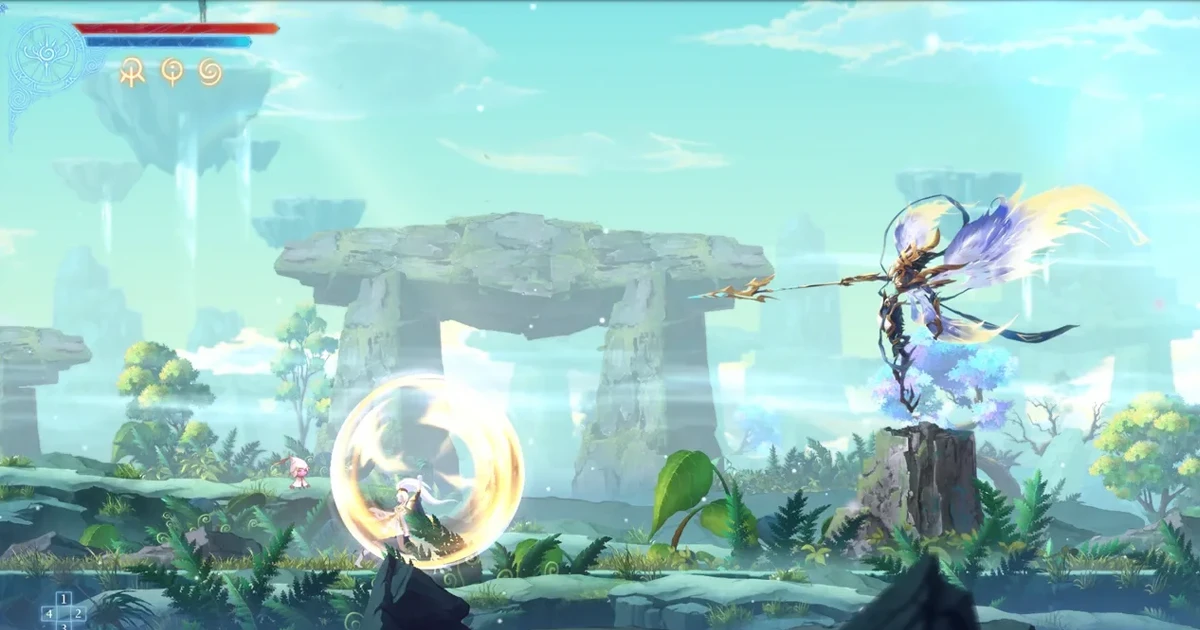
Visually, Afterimage is excellent. Its hand-drawn art style is immediately attractive, and the environmental variety gives the adventure a strong sense of wonder. The backgrounds are detailed, the character art is elegant, and many locations have a painterly quality that makes them enjoyable to move through even when the level design becomes tiring.
There is a lot of craft here. Engardin feels like a world shaped by myth and ruin, with areas that often invite you to stop and simply look. The visual design carries much of the game’s atmosphere, especially when the story itself struggles to create emotional clarity.
Enemy and boss designs are also strong. Many creatures feel distinct, and the game does a good job of making new regions feel visually fresh. This matters in a game of this size. Without such strong visual variety, the large map would be much harder to stay invested in.
If there is one area where Afterimage confidently stands beside other respected Metroidvanias, it is presentation. Even when I felt frustrated by the map or systems, I rarely stopped admiring how beautiful the game looked.
SOUND & MUSIC
The music supports the adventure well, though it does not always stand out as strongly as the visual design. The soundtrack helps give different areas their own mood, and it adds to the sense of travelling through a strange, damaged world.
Sound effects during combat are more immediately successful. Weapon hits have good impact, and the feedback of landing attacks makes combat feel satisfying. This is important because Afterimage relies heavily on repeated enemy encounters and boss fights. If the basic feel of attacking was weak, the game would suffer much more.
The main weakness in the audio presentation is the voice acting. As mentioned earlier, the delivery often feels uneven, and this affects the story’s emotional tone. In a game already dealing with a complicated world and unclear narrative structure, weak voice direction makes the story harder to follow and harder to feel.
Overall, the sound design is serviceable to good, while the voice acting is the weakest part of the presentation.
PERFORMANCE
In my experience, Afterimage’s core gameplay felt responsive enough for combat and exploration. This is important because the game asks for precise movement, quick reactions, and repeated boss attempts. A Metroidvania with poor responsiveness can quickly become frustrating, but Afterimage generally feels good in the hands.
That said, because the game includes some demanding platforming sections and harsh contact damage, any performance issues or input delay would hurt the experience more than usual. Players sensitive to precision should check the performance of their chosen platform before buying, especially if playing on handheld hardware.
DIFFICULTY
Difficulty Rating
5 / 10
Afterimage can be a challenging game, but not always for the best reasons.
When the difficulty comes from learning enemy patterns, understanding boss attacks, and improving your weapon control, the game is enjoyable. This kind of challenge feels fair because it rewards attention and patience. It asks you to observe, adapt, and improve.
The less enjoyable difficulty comes from unclear level scaling, harsh contact damage, and late-game platforming sections that can feel overly strict. Contact damage in particular can become frustrating. Even with upgraded armor, health upgrades, and defensive skills, touching an enemy or falling into hazards can remove a large portion of your health bar.
Some late-game movement sections also ask for very precise platforming. Precision challenges can be satisfying when the reward feels worth it, but in Afterimage, the reward does not always justify the effort. For completionists, this may be part of the appeal. For regular players, skipping some optional sections may lead to a better experience.
The game is not unfair all the time, but it can be uneven. Its best challenge comes from combat mastery. Its weakest challenge comes from punishment that feels too severe compared to the reward.
REPLAY VALUE
Afterimage offers strong value in terms of content. The world is large, there are many areas to explore, and the weapon variety gives players reasons to experiment across a long playthrough. Completionists will likely find plenty to do, especially if they enjoy searching for hidden rooms, optional bosses, and ability-locked secrets.
However, replay value depends heavily on how much you enjoy the game’s scale. For players who love huge Metroidvanias, Afterimage may be the kind of game they can sink many hours into. For players who prefer tighter pacing, one playthrough may be enough.
The weapon system does support replayability, but the unclear stats and limited early experimentation reduce that strength. If the game made weapon scaling and build options easier to understand, replaying with different styles would be more appealing.
As it stands, Afterimage has high content value but moderate replay value. It gives you a lot to do, but it may not always make you want to do everything.
RECOMMENDED FOR
Recommended for:
- Players who enjoy large Metroidvanias
- Fans of Castlevania-style RPG progression
- Players who like weapon variety and action combat
- Completionists who enjoy big maps and hidden secrets
- Anyone who values beautiful hand-drawn art
- Players who do not mind using guides when needed
Not recommended for:
- Players who prefer simple, focused Metroidvanias
- Players who dislike backtracking across very large maps
- Anyone who needs clear tutorials and easy-to-read RPG systems
- Players who are mainly interested in story
- Players frustrated by harsh contact damage or strict platforming
PERSONAL EXPERIENCE
My experience with Afterimage was mixed, but never without respect for what the developers attempted. I enjoy Metroidvanias, even in a time where the genre has become very crowded. What keeps the genre interesting for me is the small identity each game brings. Even when the structure is familiar, the details matter.
Afterimage has identity in its visual design and its ambition. It clearly wants to be a grand, beautiful, content-rich adventure. I admire that. It is not a lazy game, and it is not lacking effort. There is a lot of work here, and much of that work deserves praise.
At the same time, ambition needs discipline. Afterimage often feels like a game that wanted to include everything: a huge world, deep RPG systems, many weapons, Soulslike mechanics, environmental storytelling, direct dialogue, platforming challenges, and long-term progression. Some of these parts work well. Some of them compete with each other.
The combat kept me engaged the most. When I found a weapon rhythm that worked, the game became much more enjoyable. Bosses were satisfying when I felt like I had earned the win through learning and adjustment. The world also kept impressing me visually, even when the act of moving through it became tiring.
But the story never fully pulled me in, and the systems often made me feel like I was missing important information. That feeling can be uncomfortable in a game this large. There is a difference between mystery and confusion. Afterimage sometimes crosses that line.
Still, I would rather play an ambitious game with rough edges than a safe game with no personality. Afterimage may be uneven, but it has heart, beauty, and moments of real quality. It is a game I respect, even when I do not fully love every part of it.
FINAL VERDICT
Afterimage is a beautiful, ambitious, and enjoyable Metroidvania that succeeds most clearly through its combat, world art, and sense of scale. Its hand-drawn environments are often stunning, and its weapon system gives the game a satisfying action foundation. When you are fighting enemies, learning bosses, and exploring new regions, Afterimage can be very rewarding.
However, it is also a game held back by its own size and complexity. The map can feel exhausting, the story presentation is unclear, the voice acting is uneven, and several RPG systems needed better explanation. The skill tree looks impressive at first, but too many upgrades feel minor. Backtracking, contact damage, and late-game precision sections can also turn exploration into frustration.
Even so, Afterimage is not a failure. It is a sincere and impressive effort from a developer with clear talent. It simply needed more refinement, more restraint, and a stronger sense of flow.
For players who love large Castlevania-style Metroidvanias and do not mind learning through patience, Afterimage is worth playing. For players who prefer clean pacing, clear systems, and focused world design, it may be harder to recommend.
In the spirit of fair reviewing, Afterimage deserves both praise and honest critique. It is beautiful, generous, and full of effort, but also uneven, confusing, and sometimes tiring.
A flawed journey, but one with enough craft and soul to be remembered.