
GAME INFORMATION
Game Title: BlazBlue: Centralfiction
Platform Played:PlayStation 4
Available Platforms:PC, PlayStation 4, Nintendo Switch
Media Type: Physical
Developer:Arc System Works
Publisher:Arc System Works
Genre:2D Fighting Game
Release Year:2016
PLAY ENVIRONMENT
Playtime:16 hours
Completion Status:Completed
Difficulty:Normal
Graphics Mode:Default
Playthrough Type:Standard playthrough
Game Version:Original release
Controller Used:DualShock 4
Display Environment:1080p Monitor
QUICK VERDICT
BlazBlue: Centralfiction is a strong 2D fighting game with a huge roster, stylish anime presentation, deep character mechanics, and one of the most complicated stories in the genre. It is surprisingly welcoming at first thanks to its tutorials and beginner-friendly control options, but the deeper you go, the more demanding it becomes.
For long-time BlazBlue fans, this is a rich continuation filled with familiar systems, new characters, and a massive narrative payoff. For new players, it is much harder to recommend without warning. The game does a lot to help beginners understand the basics, but its story, terminology, character variety, and competitive depth can still feel overwhelming.
As a fighting game, it works well. The combat is fast, varied, and full of personality. As a story experience, it is ambitious but extremely dense. As an entry point into the series, it is possible, but not ideal.
BlazBlue: Centralfiction is not revolutionary, but it is polished, complete, and clearly made for people who already love this world.

PROS & CONS
pros
- Strong and stylish 2D fighting system.
- Large roster with over 30 varied characters.
- Excellent tutorial support for new players.
- Distinct anime visual identity.
- Beginner control options make casual play easier.
- Good long-term value for dedicated fighting game players.
cons
- Learning proper combos is not always clear.
- Combat depth can become overwhelming quickly.
- The story is extremely difficult to follow for newcomers.
STORY & NARRATIVE
BlazBlue: Centralfiction is unusual for a fighting game because its story is not just a small extra mode placed beside the combat. The story has always been one of the main pillars of BlazBlue, and Centralfiction continues that tradition fully. This is not a simple tournament story where characters fight for basic personal reasons. This is a dense science-fiction and fantasy narrative about time loops, fate, memory, death, identity, and characters trying to break free from systems that control them.
For players who have followed BlazBlue since the beginning, this is likely one of the most important parts of the game. Centralfiction feels like a continuation and a culmination. It brings back a large cast, builds on years of previous events, and expects the player to care about the world, its terminology, and its complicated relationships.
For new players, however, the story can be very difficult to enter. The game does try to help. There is an in-game encyclopedia that explains characters, concepts, and important words. There is also a story recap, but even that comes with a warning because it can take around 30 minutes. That alone says a lot about the kind of narrative this is.
The world of BlazBlue is full of terms that are treated as normal within the setting, but can sound confusing from the outside. Time loops, strange engines, hidden systems, lost memories, alternate versions of characters, and dramatic revelations all appear regularly. The story is not afraid to be complex. In some ways, this gives it personality. It makes BlazBlue feel different from many other fighting games, where story can often feel like an afterthought.
At the same time, the amount of information can become tiring. There are over 30 characters, many with their own histories, motives, and connections to previous games. The game often feels like it is trying to tie together too much at once. For the most dedicated fans, this depth may be exactly what they want. For casual players, it may be hard to stay emotionally invested when so much context is required.
The story is interesting, but not always easy to enjoy. It has ambition, style, and a clear identity, but it also asks a lot from the player. If you enjoy complicated anime stories with fate, tragedy, science-fiction concepts, and emotional conflict, there is a lot here to explore. If you prefer simple fighting game stories that exist mainly to support the action, this may feel excessive.
Centralfiction deserves credit for caring about its narrative. Even when it becomes too complicated, it is clear that Arc System Works put real effort into making BlazBlue feel like a complete world rather than just a roster of fighters.
GAMEPLAY & SYSTEMS
At its core, BlazBlue: Centralfiction is a fast 2D anime fighting game. It uses familiar fighting game foundations. Each character has a health bar, attacks reduce that health, and the goal is to defeat the opponent before they defeat you. On the surface, this is easy to understand. The difficulty comes from how each character works, how combos are built, and how quickly the game opens up once you move beyond basic attacks.
One of the strongest parts of Centralfiction is its tutorial. The game does a good job of teaching basic movement, attacks, blocking, and more advanced systems. This is important because fighting games can often feel closed off to new players. Centralfiction makes a real effort to welcome people in, even if the full depth of the game remains difficult.
There is also a beginner-friendly control option that allows players to perform flashy combos by repeatedly pressing simple buttons. This is a good addition. It lets casual players feel like they are doing something exciting without needing to memorise complicated inputs immediately. The reduced damage also means it does not completely replace proper learning. It is more of a bridge than a shortcut.
This mode is especially useful when playing casually with friends. A new player can pick a character, press buttons, see impressive attacks happen, and enjoy the match without feeling completely lost. For a game as deep as BlazBlue, that accessibility matters.
However, the deeper combat is less simple. Combos are not just about entering one long special move command. They are built around timing, positioning, and knowing which attacks can follow others. A quick jab may lead into another move, but the game does not always make it obvious what the best follow-up should be. This means new players may quickly hit a wall where they understand the controls, but do not yet understand the logic behind strong play.
Special moves are generally not too difficult to execute. Many use familiar fighting game motions like quarter-circles or half-circles. This makes the game more approachable than some older or more execution-heavy fighters. But execution is only one part of the challenge. Understanding when to use moves, how to continue pressure, how to defend, and how each opponent works takes much longer.
The signature system is each character’s Drive. This is one of the best parts of the game. A Drive is basically a unique character power, and it gives every fighter a strong individual identity. Ragna, the main character, has attacks that can drain health from the opponent and restore some of his own. This makes him feel aggressive and dangerous, rewarding players who stay close and keep attacking.
Rachel, on the other hand, plays very differently. Her Drive allows her to control wind, moving herself and her projectiles around the battlefield. This is not a simple offensive power. It changes spacing, positioning, and movement. It makes her feel technical and unusual compared to a more direct character like Ragna.
This variety is where Centralfiction shines. The roster is large, but it does not feel like a group of identical characters with different costumes. Each fighter has their own rhythm. Some want to fight up close. Some want distance. Some use strange movement. Some rely on projectiles, traps, or unusual systems. Learning one character does not mean you understand them all.
That variety gives the game long-term value, but it also makes it harder for beginners. With over 30 characters, there is a lot to learn. Even if you understand your own fighter, you still need to understand what everyone else can do. Against another new player, the game can be fun and chaotic. Against someone experienced, the gap becomes obvious very quickly.
Centralfiction is easy to start, but hard to truly understand. That is not necessarily a flaw. Many fighting games are built this way. But it does mean the game is best enjoyed by people who are willing to practise, experiment, and accept losing as part of the process.
WORLD DESIGN
BlazBlue’s world is strange, dramatic, and dense. It mixes futuristic science-fiction, fantasy, magic, military organisations, gothic character designs, and anime-style emotional conflict. Centralfiction does not present a grounded or simple setting. It is a world built on layers of lore, history, and unusual terminology.
The world design is most visible through the story, characters, and stage backgrounds. Each character feels tied to a larger system. They do not simply exist to fight. Many of them carry personal histories, rivalries, tragedies, or connections to the main conflict. This gives the roster more weight than in some fighting games.
The setting can be fascinating, but it is also heavy. The amount of lore can create distance between the player and the story. It sometimes feels like the game is speaking to people who already understand the world rather than carefully guiding new players through it. The encyclopedia helps, but needing an encyclopedia at all shows how much information there is.
Still, there is a clear identity here. BlazBlue does not feel generic. It has its own language, tone, and atmosphere. The world may be difficult to understand, but it is not lazy. It feels like a long-running anime series with years of history behind it.
VISUAL DESIGN
Visually, BlazBlue: Centralfiction has the strong anime style expected from Arc System Works. The character designs are bold, colourful, and expressive. There is also clear overlap with Guilty Gear, Arc’s other major fighting series. Some characters especially feel close in spirit to Guilty Gear’s designs, and certain main character archetypes are easy to compare.
That said, BlazBlue still has its own identity. The designs are more science-fiction heavy in places, with a mixture of gothic, military, magical, and futuristic elements. The cast is visually varied, which helps a lot in a fighting game. You can usually tell what kind of personality a character has just by looking at them.
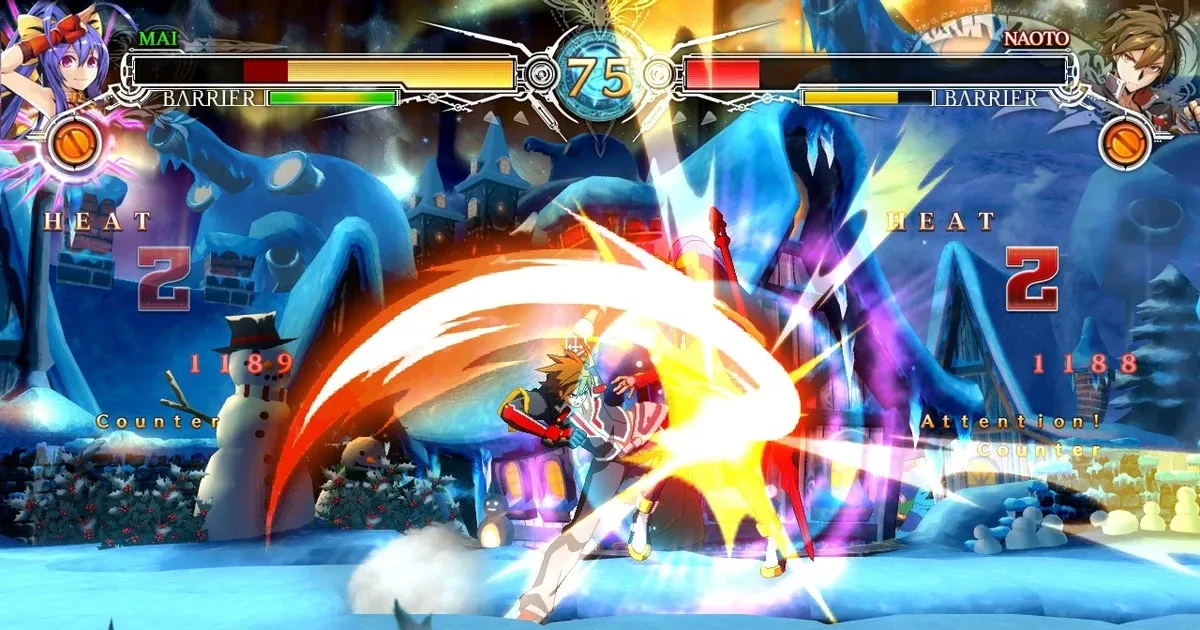
The combat animation is stylish and energetic. Attacks have impact, special moves are dramatic, and the screen often fills with colour and movement. The game understands the appeal of anime fighting games. It wants battles to look intense, even when the player is only doing simple inputs.
The visual style may not be for everyone. It is very anime, very exaggerated, and sometimes extremely busy. But for players who enjoy that style, Centralfiction delivers exactly what it should. It looks sharp, confident, and full of personality.
SOUND & MUSIC
The sound design supports the fast and dramatic tone of the game well. Hits feel sharp, special attacks have strong audio feedback, and the voice work gives the characters extra energy. Like many anime fighters, the game relies heavily on character voices during battle, which adds intensity but may feel noisy depending on personal taste.
The music fits the style of the game. It is energetic, dramatic, and built to support fast battles. It does not completely redefine fighting game music, but it does its job well. The soundtrack helps maintain momentum and gives matches a sense of excitement.
For story scenes, the sound and voice acting help carry the emotional tone. Since the narrative is so dense, strong presentation is important. The performances help make the characters feel more alive, even when the story itself becomes difficult to follow.
Overall, the sound and music are strong without being the main reason to play. They support the experience cleanly and give the game the energy it needs.
PERFORMANCE
BlazBlue: Centralfiction performs well as a 2D fighter. The action is smooth, responsive, and clear enough during normal play. In a fighting game, performance matters because every input, movement, and reaction can affect the result of a match. Centralfiction feels stable and reliable in this area.
The game is fast, but it does not feel messy from a technical perspective. When the screen becomes full of effects, it can be visually busy, but that is more of a style issue than a performance problem. The core fighting remains responsive.
For casual play, story mode, and offline matches, there are no major issues. The game feels polished and complete, which is expected from Arc System Works.
DIFFICULTY
Difficulty Rating
6 / 10
Centralfiction is welcoming at the start, but difficult in the long term. The tutorial, beginner controls, and basic combat structure make it easy to begin. A casual player can pick a character, press buttons, and have fun. This is one of the game’s strengths.
The difficulty comes later. Once you want to play properly, the game becomes much deeper. You need to learn combo routes, character matchups, Drive mechanics, defence, spacing, pressure, and timing. Because each character is so different, every matchup can feel like a new lesson.
The biggest difficulty for new players is not performing special moves. Many inputs are manageable. The harder part is understanding what to do after each hit, how to create openings, and how to stop an opponent who already knows their character.
This makes Centralfiction a game with two faces. Casually, it can be fun and accessible. Competitively, it is demanding and sometimes intimidating. New players should expect a real learning curve.
REPLAY VALUE
BlazBlue: Centralfiction has strong replay value if you enjoy fighting games. The large roster gives players many characters to test, learn, and master. Because every character has a unique Drive and different playstyle, switching fighters can almost feel like learning a new game.
The story mode also gives fans a lot to work through. It is long, detailed, and full of lore. Players who care about BlazBlue’s world will find plenty of material here.
The long-term value depends heavily on the player. If you only want a simple fighting game to play for a few hours, Centralfiction may feel like too much. If you enjoy training mode, learning systems, testing characters, and slowly improving, there is a lot here.
This is not a game that gives everything away quickly. It rewards patience.
RECOMMENDED FOR
Recommended for:
- Fans of anime fighting games.
- BlazBlue fans who want the continuation of the story.
- Players who do not mind complicated stories.
- Players who like large rosters with very different characters.
Not recommended for:
- Players who want a simple, easy-to-follow story.
- People who dislike anime-style presentation.
- Anyone who only wants a casual fighter with minimal systems.
PERSONAL EXPERIENCE
My experience with BlazBlue: Centralfiction was mixed, but mostly positive. The game is clearly well made. It has strong mechanics, a large cast, good tutorials, and a lot of personality. It is easy to respect the amount of work that has gone into it.
The combat was enjoyable, especially when testing different characters and seeing how unique their Drive abilities were. Ragna felt direct and easy to understand, while characters like Rachel showed how unusual and technical the roster can become. That variety is one of the most impressive parts of the game.
At the same time, I found the game difficult to fully connect with as a newcomer. The story is interesting, but it is also extremely complicated. I respect the ambition, but there were moments where the amount of terminology and background information made it harder to stay invested. It feels like a game made mainly for people who have already walked the path from the beginning.
The beginner-friendly options helped make the combat easier to enjoy casually. Being able to mash simple attacks and still perform stylish combos made the game more approachable. But once I tried to understand the deeper systems, it became clear that Centralfiction is not a simple game. It welcomes new players at the door, but the real room is much deeper inside.
That is not a bad thing. It just means the game requires patience. This is a fighter that gives back what you put into it. If you only want surface-level fun, it can provide that. If you want to master it, there is a long road ahead.
FINAL VERDICT
BlazBlue: Centralfiction is a strong, polished, and content-rich 2D fighting game. It does not completely reinvent the series, but it does not need to. Instead, it expands what already worked: fast anime combat, deep character variety, dramatic presentation, and an unusually large focus on story.
Its biggest strength is the roster. With over 30 fighters and unique Drive mechanics for each character, there is a lot of depth to explore. The game is not just about choosing who looks cool. Each character brings a different rhythm, strategy, and learning process. This gives Centralfiction excellent long-term value for players who enjoy mastery.
Its biggest weakness is accessibility beyond the basics. The tutorial and beginner controls help new players start, but the deeper game remains complex. The story is even harder to approach. It is ambitious and full of personality, but also extremely convoluted. For fans, that may be part of the appeal. For newcomers, it can feel like entering a conversation that has been happening for years.
Centralfiction is not mind-blowing, but it is very solid. It does what a continuation should do. It gives fans more characters, more story, more systems, and more reasons to keep playing. It may not convert everyone, and it may not be the cleanest entry point into BlazBlue, but as a complete fighting game package, it succeeds.
For dedicated fighting game players and BlazBlue fans, this is easy to recommend. For casual players, it is worth trying, but only with the understanding that beneath the stylish surface is a very deep and demanding game.
BlazBlue: Centralfiction is a game of complexity, style, and patience. It may not be for everyone, but for the right player, there is a lot to discover.