
GAME INFORMATION
Game Title: BlazBlue: Calamity Trigger
Platform Played:PlayStation 3
Available Platforms:Arcade, PlayStation 3, Xbox 360, PSP, PC, Steam
Media Type: Physical
Developer:Arc System Works
Publisher:Arc System Works / Aksys Games / PQube
Genre:2D Fighting Game
Release Year:2009
PLAY ENVIRONMENT
Playtime:16 hours
Completion Status:Completed
Difficulty:Normal
Graphics Mode:Default
Playthrough Type:Standard playthrough
Game Version:Original release
Controller Used:DualShock 3
Display Environment:CRT TV
QUICK VERDICT
BlazBlue: Calamity Trigger is one of those fighting games that immediately shows you what kind of studio made it. It is stylish, fast, strange, loud, beautiful, and full of small details that only a team like Arc System Works would care about.
At first glance, it can look intimidating. The screen moves quickly, the characters are unusual, the terminology is dramatic, and the story feels like it has been pulled from a dense anime or visual novel. But underneath all of that, BlazBlue is surprisingly welcoming. It gives beginners simple tools, clear attacks, and flashy character-specific abilities, while still offering serious depth for players who want to study matchups, cancels, movement, and character mechanics.
It is not a fighting game for everyone. Players who prefer grounded, simple, realistic combat may find it too chaotic or too anime-inspired. But for those who enjoy expressive characters, fast aerial movement, stylish combat, and deep systems, BlazBlue: Calamity Trigger is a brilliant first entry in the series.
It feels like a spiritual successor to Guilty Gear, but it also has its own identity. It is polished, confident, generous with content, and full of personality. Even years later, it remains a special 2D fighter.

PROS & CONS
pros
- Beautiful 2D visual design
- Fast, responsive combat
- Strong character variety
- Beginner-friendly basic controls
- Excellent music
- Strong replay value
cons
- Limited appeal for players who dislike anime-style fighters
- Story can be confusing at first
- Roster is smaller than later BlazBlue entries
STORY & NARRATIVE
For a fighting game, BlazBlue: Calamity Trigger puts a surprising amount of effort into its story. This is not just a simple arcade ladder where characters fight for vague reasons and disappear after the credits. Instead, the game presents a layered anime-style narrative with branching character paths, strange terminology, rivalries, hidden motives, and a world that slowly reveals itself through repeated play.
The story follows a future world shaped by magic, technology, military power, and conflict. At the centre of this world is Ragna the Bloodedge, a wanted man with a massive sword, a dark power, and a direct connection to many of the game’s central mysteries. Around him are characters like Jin Kisaragi, Noel Vermillion, Rachel Alucard, Taokaka, Bang Shishigami, Carl Clover, and many others, each bringing their own role into the wider story.
The narrative can be confusing at first. BlazBlue uses a lot of proper nouns, dramatic dialogue, and mysterious references before the player fully understands what is happening. It feels very Japanese in that sense. It does not always explain itself immediately. Instead, it expects you to spend time with the characters, play through different routes, and slowly piece things together.
This approach will not work for everyone. If you prefer fighting game stories to be simple and direct, BlazBlue may feel too busy. But if you enjoy anime, visual novels, JRPGs, or character-driven worldbuilding, there is a lot to enjoy here. The story has emotion, humour, rivalry, tragedy, and absurdity. It is serious one moment, then completely ridiculous the next.
What makes it work is the cast. Ragna and Jin clearly echo the classic Sol and Ky energy from Guilty Gear, but their relationship has its own flavour. Ragna feels like the rough, rebellious lead, while Jin carries a colder and more unstable presence. Noel adds a softer emotional centre, while characters like Rachel, Bang, and Taokaka bring a huge amount of personality and charm.
The story is not perfect. It can be messy and overcomplicated. But it gives the game a strong identity. It makes the characters feel like more than movesets. In a genre where story is often secondary, BlazBlue makes its narrative part of the appeal.
GAMEPLAY & SYSTEMS
BlazBlue: Calamity Trigger is a 2D fighting game built around speed, expression, and character individuality. It shares a lot of DNA with Guilty Gear, especially in its fast movement, aerial combat, stylish attacks, and heavy anime influence. But it is not just Guilty Gear with a new name. BlazBlue has its own rhythm and its own approach to character design.
The basic control scheme is clean. There are four main attack buttons: A, B, C, and D. A, B, and C are normal attacks of increasing strength, while D is the Drive button. The Drive system is one of BlazBlue’s smartest ideas. Every character has a unique Drive ability that defines how they play.
This makes the game easy to understand at a surface level but very deep once you start learning individual characters. Ragna’s Drive allows him to drain health. Jin uses ice-based attacks. Rachel can manipulate wind. Carl can control his puppet, Nirvana. Tager is slow and heavy but terrifying once he gets close. These Drive abilities are not just small gimmicks. They shape the entire personality of each fighter.
For beginners, this is great because pressing D often produces something cool and useful. You do not need to master difficult inputs immediately to feel stylish. You can press buttons, move around, use Drive attacks, and start to understand what your character is about.
For advanced players, the system opens up much further. BlazBlue includes Barriers, Rapid Cancels, Distortion Drives, Astral Finishers, Heat gauge management, air dashes, special movement options, and character-specific mechanics. It rewards training, experimentation, and matchup knowledge.
Rapid Cancels are especially important. They allow you to cancel the animation of certain attacks and continue pressure or extend combos, but they cost Heat. This gives the combat a strong sense of decision-making. Do you spend meter to continue an attack? Save it for a Distortion Drive? Use it defensively? Go for something flashy?
The pace is fast. BlazBlue is not a slow, grounded fighter. It wants you to move, jump, dash, pressure, escape, and react quickly. Matches can become intense very quickly, especially when both players understand their characters. This speed is part of the game’s identity, but it can also be intimidating for new players.
Still, the game does a good job of making the basics feel accessible. Simple attack chains, familiar quarter-circle inputs, and strong character tools help new players get started. The depth is there when you want it, but the first step is not as harsh as it may appear.
The roster is smaller compared to later entries, but each character feels carefully made. This is one of the game’s greatest strengths. Instead of giving the player many similar fighters, BlazBlue gives each character a clear identity. Learning a new character almost feels like learning a different fighting game.
WORLD DESIGN
As a fighting game, BlazBlue does not have world design in the same way as an RPG or action-adventure game. But it still builds a strong world through its stages, menus, character emblems, story presentation, and terminology.
The world of BlazBlue feels strange, mechanical, magical, and theatrical. It has military structures, gothic architecture, ruined spaces, mystical powers, and science-fantasy ideas all mixed together. It feels like a setting designed for anime drama, and that works well for this type of game.
The stages are not just flat backgrounds. They help sell the mood of the universe. They are colourful, detailed, and full of atmosphere. Some feel grand and elegant, while others feel darker or more chaotic. This gives each fight a sense of place, even when the match itself is mechanically focused.
The menus and extra details also help. Arc System Works clearly cared about presentation. Character icons, gallery items, unlockables, replay options, and small visual touches make the game feel complete. It does not feel like a bare fighting game package. It feels like a world the developers wanted players to spend time in.
VISUAL DESIGN
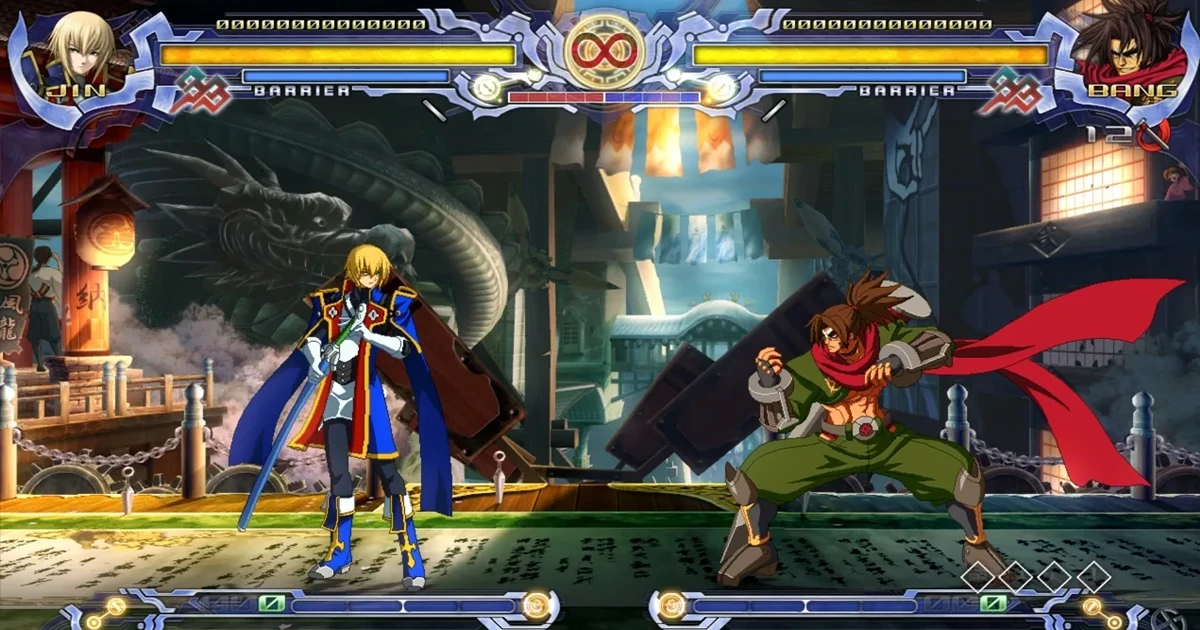
Visually, BlazBlue: Calamity Trigger is beautiful. This is one of the game’s strongest areas. The sprites are sharp, expressive, and full of character. The animation has weight and style. Attacks look powerful, movement feels fluid, and each character has a strong silhouette.
Arc System Works has always understood how to make 2D fighters look exciting, and BlazBlue continues that tradition. The game has a clean high-definition look that helped it stand out when it first released. Even now, the art direction remains impressive because it is not chasing realism. It has a strong style, and strong style ages better than raw technology.
The character designs are bold. Ragna has the oversized sword and rebellious red-black look. Jin is colder and more elegant. Noel has a military-inspired design mixed with vulnerability. Rachel looks like a gothic vampire princess. Bang is loud, heroic, and ridiculous. Tager is huge and disproportionate in a way that immediately tells you what kind of fighter he is.
Some designs may be too much for certain players. BlazBlue is proudly anime. It is not subtle, grounded, or restrained. But that is also the point. The game knows what it is. It commits fully to its visual identity.
The backgrounds are also excellent. They are colourful, detailed, and often beautiful to look at. Combined with the character animation and effects, BlazBlue creates a strong visual rhythm. It is busy, but rarely ugly. It feels alive.
SOUND & MUSIC
The music is excellent and fits the game perfectly. BlazBlue has the kind of soundtrack that gives every fight energy. It is dramatic, fast, and intense, with strong rock and anime-style influences. It carries the same spirit that made Guilty Gear’s music so memorable, while giving BlazBlue its own sound.
The character themes help build identity. They make rivalries feel bigger, fights feel more dramatic, and arcade runs feel more exciting. The music supports the speed of the combat without becoming background noise.
Sound effects are also strong. Hits feel sharp, special moves have impact, and the overall sound design gives the combat a satisfying rhythm. In a fast fighting game, feedback matters. You need attacks to feel clear and responsive. BlazBlue succeeds here.
The voice acting and story presentation add to the anime atmosphere. Some players may find it dramatic or excessive, but it suits the game. BlazBlue is not trying to be quiet or realistic. It is theatrical, emotional, and stylish.
PERFORMANCE
BlazBlue: Calamity Trigger performs well and feels responsive. For a fighting game, this is essential. The controls need to feel immediate, the animation needs to remain readable, and the game needs to maintain a stable feel during fast matches.
In offline play, the game feels smooth and clean. Inputs are responsive, attacks come out as expected, and the overall pace feels consistent. This makes training mode, arcade mode, and local multiplayer enjoyable.
Online play is more difficult to judge now because the game is older and online conditions vary depending on version and platform. At the time, the online mode was a strong feature, especially with replay saving. Being able to save and study matches added serious value for players who wanted to improve.
The replay theatre is a great inclusion. Watching matches at normal speed, sped up, or frame-by-frame gives players a way to study mistakes and understand situations more deeply. The lack of rewind is a small issue, but it does not ruin the feature. It just makes reviewing certain moments less convenient.
Overall, the game feels polished. There is a clear sense that Arc System Works thought carefully about what fighting game players would want.
DIFFICULTY
Difficulty Rating
6 / 10
BlazBlue is easy to start but difficult to master. That is one of the best things about it.
A beginner can pick a character, press A, B, C, use the Drive button, block, jump, and have fun. The game gives you enough simple tools to feel involved early. You do not need to understand every system to enjoy your first matches.
However, once you start taking the game seriously, the difficulty rises quickly. Each character has unique mechanics. Movement is fast. Air options matter. Meter management matters. Matchups matter. Defensive choices matter. The difference between casual play and skilled play is huge.
Some characters are much harder than others. Carl, for example, requires puppet control, which demands a very different type of awareness. Rachel’s wind control also asks the player to think beyond basic attacks. Tager, meanwhile, requires patience and strong positioning because of his slower movement.
This gives the game strong long-term depth, but it can overwhelm players who want a simpler fighter. BlazBlue rewards commitment. It is not impossible for newcomers, but it does ask you to learn if you want to improve.
REPLAY VALUE
BlazBlue has excellent replay value, especially for fighting game fans. The character roster may be smaller than later entries, but each fighter is so distinct that learning them adds many hours of play.
Story mode gives each character branching paths, which encourages multiple playthroughs. Arcade mode is useful for quick sessions. Training mode is essential for learning combos and systems. Score Attack gives more challenge. The gallery and unlockables add extra motivation. Replay Theatre gives players a reason to study matches and improve.
The biggest source of replay value is the combat itself. Because characters play so differently, the game stays interesting. Moving from Ragna to Rachel, or from Jin to Carl, changes the way you think. This makes experimentation rewarding.
For casual players, there is enough single-player content to enjoy. For competitive players, the systems offer plenty to study. For anime fans, the story and character interactions give extra value.
RECOMMENDED FOR
Recommended for:
- Fans of Guilty Gear
- Fans of anime-style fighting games
- Players who enjoy fast 2D combat
- JRPG and anime fans who want a fighting game with story
- People who like deep character mechanics
Not recommended for:
- Players who dislike anime aesthetics
- Players who prefer slower, grounded fighters
- Anyone looking for a very simple casual party fighter
PERSONAL EXPERIENCE
BlazBlue: Calamity Trigger feels like a dream fighting game for a very specific type of player. If you love Arc System Works, Guilty Gear, anime visuals, expressive combat, and strange character concepts, this game feels immediately comfortable.
What stands out most is how complete it feels. The combat is strong, but the appeal goes beyond mechanics. The menus, music, art, story mode, gallery, replay options, and character details all create the feeling of a carefully crafted package. It does not feel empty. It feels loved.
I also appreciate how the game balances simplicity and depth. On the surface, four buttons make it approachable. The Drive button gives every character an easy way to feel unique. But beneath that, the game has enough advanced systems to keep players learning for a long time.
The characters are the heart of the experience. Ragna, Jin, Noel, Rachel, Bang, Carl, Tager, and the rest of the cast all bring something memorable. Even when a character is strange or exaggerated, they feel intentional. The designs may not appeal to everyone, but they are never boring.
This is also where BlazBlue’s limited appeal becomes clear. It is not trying to be Street Fighter. It is not trying to be Tekken. It is not trying to be realistic or universal. It is a fast, stylish, anime-heavy 2D fighter with its own rules and its own atmosphere. That confidence is exactly why it works.
FINAL VERDICT
BlazBlue: Calamity Trigger is an outstanding 2D fighting game and a brilliant first step for the BlazBlue series. It takes the energy and style Arc System Works was known for and builds a new world around it, filled with memorable characters, fast combat, beautiful visuals, and deep mechanics.
It is beginner-friendly enough to enjoy casually, but deep enough to reward serious practice. The Drive system gives every character a strong identity, while mechanics like Rapid Cancels, Barriers, Distortion Drives, and Astral Finishers give the combat long-term depth.
The story can be confusing, and the anime style will not appeal to everyone. Some players may find the pace too fast or the character designs too strange. But for the audience it is aiming at, BlazBlue is excellent.
It is polished, generous, stylish, and full of personality. It respects fighting game fans while still giving newcomers something exciting to hold onto. More than anything, it feels like a game made with confidence.
For fans of Arc System Works, anime fighters, or fast 2D combat, BlazBlue: Calamity Trigger is absolutely worth playing. It is not just a strong fighting game. It is a statement of identity.
A beautiful beginning to one of the most distinctive fighting game series of its era.