
GAME INFORMATION
Game Title: Captain Tsubasa: Rise of the New Champions
Platform Played:PlayStation 4
Available Platforms:PlayStation 4, Nintendo Switch, PC
Media Type: Physical
Developer:Tamsoft
Publisher:Bandai Namco Entertainment
Genre:Anime Sports, Action
Release Year:2020
PLAY ENVIRONMENT
Playtime:24 hours
Completion Status:Completed
Difficulty:Default
Graphics Mode:Default
Playthrough Type:Standard playthrough
Game Version: Latest Version
Controller Used:DualShock 4
Display Environment:1080p Monitor
QUICK VERDICT
Captain Tsubasa: Rise of New Champions is not a traditional football simulation. It is loud, dramatic, emotional, and completely committed to being an anime sports game. It takes the heart of Captain Tsubasa and turns football into something closer to an action RPG, where every pass, tackle, shot, and save feels like part of a larger battle.
It can be slow during its visual novel-style story scenes, and the difficulty can feel uneven, especially in Episode: New Hero. However, when the match begins and the game lets its systems breathe, it becomes a surprisingly compelling mix of competition, strategy, and over-the-top anime spectacle.
For players who want realistic football, this may feel too strange. For players who love Japanese games, anime storytelling, and exaggerated sports drama, this is a charming and memorable experience.

PROS & CONS
pros
- Strong anime presentation
- Beautiful manga-inspired visual style
- Exciting special shots and dramatic match animations
- More strategic depth than it first appears
- Captures the spirit of Captain Tsubasa well
cons
- Difficulty can feel uneven
- Not ideal for realistic football fans
- New Hero starts slowly due to limited early abilities
STORY & NARRATIVE
Captain Tsubasa has been part of Japanese football culture for decades. The manga first appeared in 1981, with anime adaptations following from 1983 onwards. At its heart, the story is very simple: a young boy named Tsubasa Ozora dreams of playing for Japan and reaching the World Cup. It is a story about ambition, friendship, teamwork, rivalry, and chasing something that feels almost impossible.
That simplicity is part of its strength. Tsubasa is not a complicated protagonist, but he is easy to support. He loves football completely, and Rise of New Champions understands that. The game treats every match like another step toward a dream, not just another fixture to clear.
The game contains two main story modes. The first is Episode: Tsubasa, which follows Tsubasa Ozora and his rise through school football. This mode works well as an introduction to the world, the characters, and the tone of Captain Tsubasa. It gives context to the matches and helps the player understand why these rivalries matter.
The biggest weakness is the pacing. Much of the story is told through long visual novel-style dialogue scenes. These scenes are not bad, and they help preserve the anime feeling, but they can drag on. Sometimes you simply want to get back onto the pitch and play. When the game is building toward an important match, the long conversations can make the energy dip.
The second story mode, Episode: New Hero, is where the game becomes more personal. Here, you create your own player, choose one of three schools, build relationships, learn skills, and slowly shape your football identity. This mode gives the game a stronger sense of ownership. You are no longer only watching Tsubasa’s path. You are walking your own.
The relationship system is a nice touch. Dialogue choices help you bond with other players, and those bonds influence what skills you can learn. It gives the campaign a light RPG structure, where improvement comes not only from winning matches, but from understanding the players around you. It fits the themes of Captain Tsubasa well. Football is not only about talent. It is also about connection.
Episode: New Hero is also where certain characters begin to stand out more. After seeing different playstyles in Episode: Tsubasa, you start to know who you want to learn from. In my case, Shingo Takasugi stood out immediately. His strength and power made him feel almost unstoppable, and even when playing in attack, I wanted some of that presence in my own character.
The story is not subtle, but it does not need to be. This is a game about big feelings, impossible shots, fierce rivals, and the belief that effort can carry you forward. In that sense, it captures the soul of Captain Tsubasa very well.
GAMEPLAY & SYSTEMS
Although Captain Tsubasa: Rise of New Champions takes place on a football pitch, it does not play like FIFA or PES. This is not a simulation built around realism, formations, and careful recreation of the sport. It is more like an action game using football as its battlefield.
You still pass, dribble, shoot, defend, and score. Ground passes, long passes, and through balls all matter, and positioning is still important. However, the real identity of the game comes from its stamina systems, special moves, dramatic animations, and one-on-one battles.
The most interesting system is how goalkeepers work. In most football games, shooting is about timing, angle, power, and placement. Here, goalkeepers feel more like bosses. You usually cannot score just by taking a normal shot early in the match. Instead, every saved shot damages the goalkeeper’s Spirit Gauge. As their spirit drops, your chances of scoring increase.
This changes the rhythm of a match. Attacking is not simply about finding one perfect chance. It becomes a process of wearing down the keeper, building pressure, and choosing the right moment to use a powerful shot. The match becomes a battle of endurance.
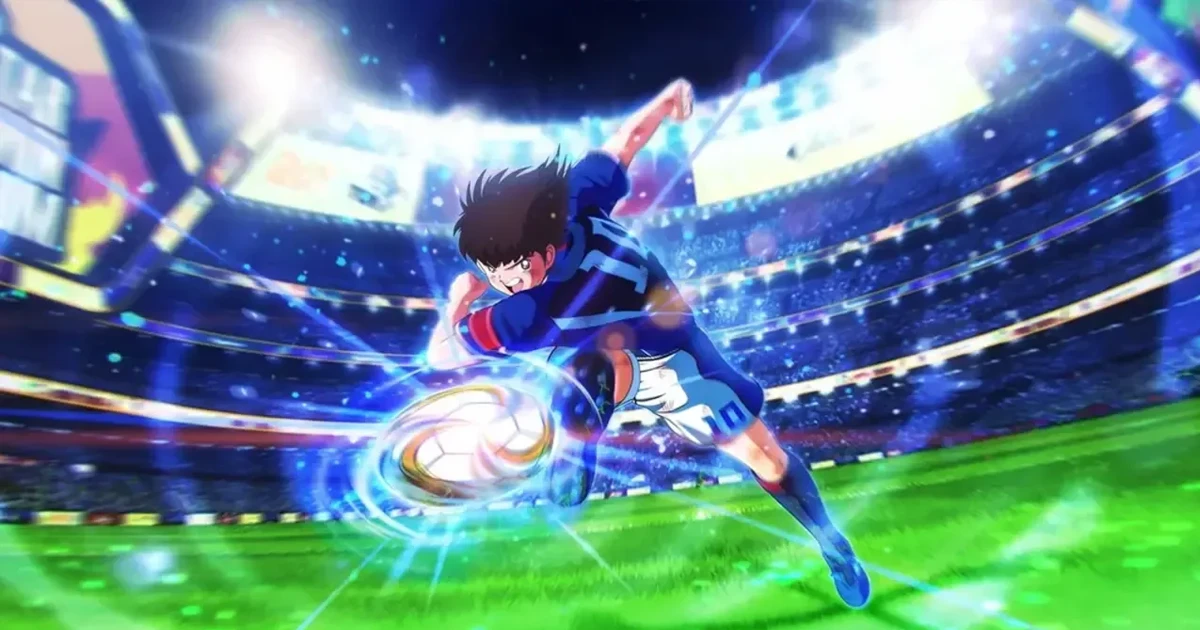
Special shots are the heart of the experience. Moves like the Falcon Shot or Tiger Shot explode into animated cutscenes, turning a normal attempt on goal into a full anime moment. These sequences can sometimes feel jarring because they interrupt the flow of play, but they are also part of the game’s charm. Without them, Captain Tsubasa would lose much of its personality.
Dribbling and dodging are also important. Getting past opponents can open up chances for stronger shots, and chaining successful actions together gives the player more control over the match. Defenders can block shots with their own dramatic animations, while certain clashes turn into direct button-mashing battles where both players fight for control.
There is also a team-based power system that allows your side to become more efficient for a limited time. During this state, stamina drains more slowly and your team can perform at a higher level. Used well, it can completely change the momentum of a match.
This is where the game becomes much deeper than it first appears. On the surface, it looks like a flashy anime football game. Underneath, there are plenty of hidden strategic elements. You need to think about stamina, keeper spirit, player skills, timing, positioning, and when to commit to a special move.
It is not always smooth. The animations can interrupt the pace, and some systems are not explained as clearly as they could be. However, once everything clicks, Rise of New Champions becomes very satisfying. It is not football as reality. It is football as imagination.
WORLD DESIGN
As a sports game, Captain Tsubasa: Rise of New Champions does not have world design in the traditional open-world sense. Its world is built through schools, teams, rivalries, tournaments, and characters.
The structure works because every team feels like another step in the journey. Matches are not just isolated events. They are story battles, each one carrying a sense of progression. The schools in Episode: New Hero also give the game a nice sense of identity, as your starting choice affects your early path and the type of player you begin to become.
The world is simple, but effective. It understands that Captain Tsubasa is not about exploring places. It is about chasing a dream across the pitch, one match at a time.
VISUAL DESIGN
Visually, Rise of New Champions is one of the game’s strongest areas. Tamsoft does a great job of making the characters resemble the manga and anime. The models are clean, colourful, and expressive, with thick outlines and sharp animation that help the game stand apart from more realistic sports titles.
The pitch action maintains this style well. Characters move with exaggerated energy, and the special shots bring the anime tone to life. The game looks especially strong during cinematic moments, whether it is a powerful strike, a desperate block, or the opening sequence before an exhibition match.
The tunnel walks, team line-ups, and pre-match scenes give the game a grand feeling. It treats football like a stage, and every player like someone about to enter a dramatic battle.
The visual style will not appeal to everyone, but for fans of anime sports stories, it feels right. It is bright, intense, and full of spirit.
SOUND & MUSIC
The sound design supports the anime energy well. Special moves have impact, the crowd adds atmosphere, and the match audio gives the game a constant sense of movement.
The commentary is strangely enjoyable. It does not always sound natural, and some lines can feel unintentionally funny, but that almost adds to the charm. Hearing simple comments about good kicking or nice running makes the game feel oddly wholesome. It does not have the polished realism of a major football broadcast, but that is not really what the game is trying to be.
The music and voice work help preserve the anime feeling. The emotional scenes may sometimes run too long, but the sound presentation keeps them connected to the spirit of the source material.
PERFORMANCE
Performance is generally solid, though the experience may vary depending on platform. The most noticeable interruptions are not technical problems, but the frequent animated sequences during matches. These are intentional, but they can affect the feeling of flow.
In a normal football game, constant cut-ins would be a problem. Here, they are part of the identity. Even so, players who prefer fast, uninterrupted matches may find them tiring after a while.
For the most part, Rise of New Champions presents its action clearly and keeps the match experience stable enough to enjoy.
DIFFICULTY
Difficulty Rating
5 / 10
Captain Tsubasa: Rise of New Champions can be surprisingly challenging. Episode: Tsubasa gives you access to stronger characters and teaches the basic rhythm of the game, but Episode: New Hero is much tougher at the beginning.
The reason is simple: your created player starts with very few skills. You do not yet have the power, stamina, or special techniques that make the stronger characters feel so exciting. Early matches can feel difficult because you are still weak, and the game expects you to learn quickly.
However, this also gives Episode: New Hero its sense of satisfaction. As your player improves, the game becomes more rewarding. Learning new skills, building friendships, and slowly becoming more effective on the pitch creates a strong feeling of growth.
The difficulty is not always perfectly balanced, but it fits the theme. You begin as someone unfinished. Through effort, connection, and repeated struggle, you become stronger.
REPLAY VALUE
Rise of New Champions has good replay value for the right type of player. Episode: New Hero can be replayed with different schools, different builds, and different relationship paths. The character creation and skill-learning systems encourage experimentation, especially if you want to make a player inspired by your favourite characters.
There are also exhibition matches and online modes, though the online side may not appeal to everyone. Because the game is so exaggerated and animation-heavy, it is not ideal for players who want pure competitive balance. It is fun, but it is not a serious football simulation.
The strongest replay value comes from the desire to build a better hero, learn new skills, and experience the game’s dramatic football again with a stronger understanding of its systems.
RECOMMENDED FOR
Recommended for:
- Fans of Captain Tsubasa
- Anime sports fans
- People who enjoy over-the-top Japanese game design
- Players who enjoy arcade football games
Not recommended for:
- Players who want realistic football simulation
- People who dislike long dialogue scenes
- Anyone expecting a traditional football career mode
PERSONAL EXPERIENCE
What surprised me most about Captain Tsubasa: Rise of New Champions is how quickly it became compelling. I expected a simple anime football game, but it has more going on than it first appears. The goalkeeper system, stamina management, special shots, and relationship-building all work together to create something unique.
The game is at its best when it stops trying to behave like normal football and fully embraces what it is. This is a game where a shot can feel like a finishing move, a goalkeeper can feel like a boss, and a school football match can feel like a final battle.
I also enjoyed how Episode: New Hero gave me a reason to care about my own player. Starting weak made the early matches harder, but it also made improvement feel meaningful. Slowly learning from other players and shaping my style gave the mode a satisfying rhythm.
It is not a perfect game. The dialogue scenes can drag, the difficulty can spike, and the animations can sometimes get in the way of the match flow. But the heart of the game is strong. It feels sincere. It understands that Captain Tsubasa is not only about football. It is about dreams, effort, friendship, and the courage to keep running forward.
FINAL VERDICT
Captain Tsubasa: Rise of New Champions is a strong anime sports game that succeeds because it refuses to be ordinary. It is not trying to replace realistic football games. Instead, it creates its own space, somewhere between arcade sports, action game, visual novel, and light RPG.
Its long dialogue scenes and uneven difficulty may test some players, but its charm, visual style, and energetic match systems make it easy to forgive. The game captures the spirit of Captain Tsubasa with care, turning every match into a dramatic contest of willpower.
For football simulation fans, it may feel too strange. For anime fans, Japanese game fans, and players who enjoy games with heart, it offers something much more memorable.
Captain Tsubasa: Rise of New Champions is not just about scoring goals. It is about chasing a dream with everything you have.