
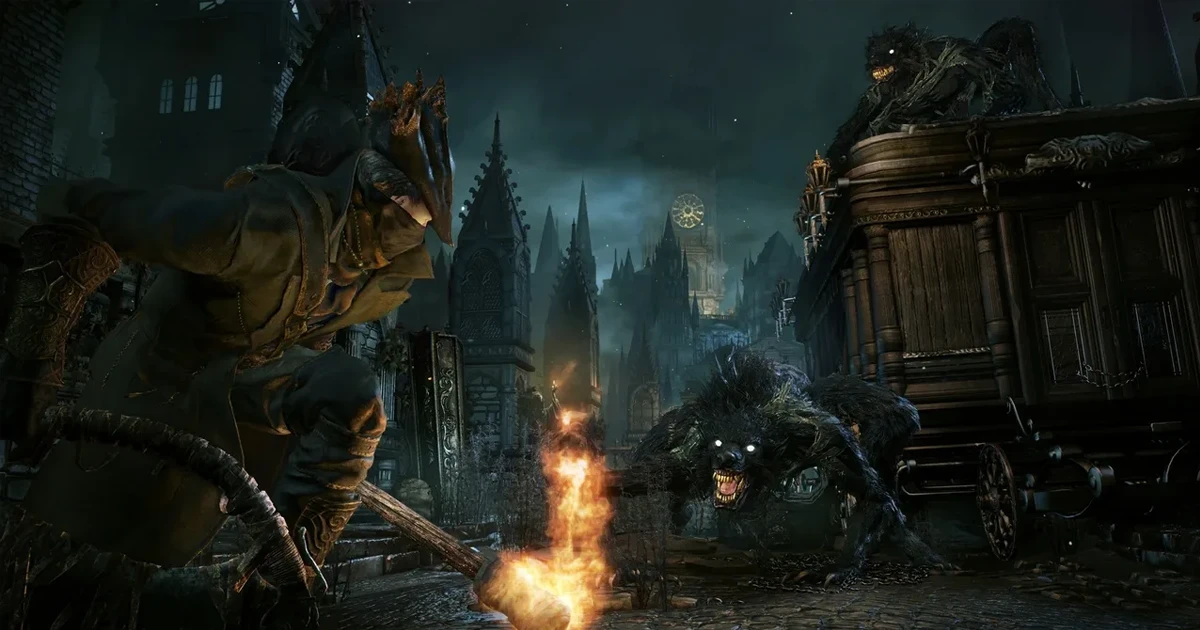
GAME INFORMATION
Game Title: Bloodborne
Platform Played:PlayStation 4
Available Platforms:PlayStation 4
Media Type: Physical Disc
Developer:FromSoftware
Publisher:Bandai Namco Entertainment / FromSoftware
Genre:Mecha Action RPG
Release Year:2015
PLAY ENVIRONMENT
Playtime:60 hours
Completion Status:Platinumed
Difficulty:Default
Graphics Mode:Default
Playthrough Type:Blind playthrough
Game Version: Latest Version
Controller Used:DualSense
Display Environment:1080p Monitor
QUICK VERDICT
Bloodborne is one of FromSoftware’s strongest works. It is violent, elegant, exhausting, mysterious, and deeply rewarding. It takes the slow, defensive rhythm of earlier Souls games and reshapes it into something faster, sharper, and more aggressive. Every dodge, every counterattack, every shortcut, and every boss victory feels earned.
What makes Bloodborne special is not just its difficulty. It is the way that difficulty supports the world, the atmosphere, and the feeling of being a hunter trapped inside a nightmare. Yharnam is not simply a place to explore. It feels diseased, alive, and quietly watching you. The more you push forward, the more the world seems to open its eyes.
The game is not perfect. The frame rate struggles at times, loading can damage the rhythm, and some systems remain deliberately unclear. However, even with these issues, Bloodborne remains a powerful, unforgettable action RPG. It is a game about fear, patience, violence, discovery, and transformation.
It demands a lot from the player, but it gives back even more.

PROS & CONS
pros
- Incredible gothic and cosmic horror atmosphere
- Fast, aggressive, satisfying combat
- Brilliant weapon design with trick weapons
- Memorable boss fights and enemy designs
- Strong sense of progression and mastery
- Excellent environmental storytelling
- Powerful art direction
- One of FromSoftware’s most distinctive identities
cons
- Loading screens hurt the pacing
- Some systems are poorly explained
STORY & NARRATIVE
Bloodborne tells its story quietly. It does not sit the player down and explain the world, the characters, or the meaning behind every event. Instead, it places you inside the city of Yharnam and lets you feel the horror for yourself.
At first, the story appears simple. You arrive in Yharnam, a city known for blood healing, and become involved in a hunt against beasts. The streets are filled with madness, disease, burning bodies, locked doors, and citizens who either fear you or curse you. It feels like a gothic nightmare built from sickness, religion, and violence.
But Bloodborne slowly changes shape.
What begins as a hunt against werewolf-like monsters becomes something much stranger. The game moves from gothic horror into cosmic horror, where the real terror is not just the beast in front of you, but the truth behind the world itself. The more you learn, the less stable everything feels. Faith, medicine, knowledge, blood, birth, and worship all become twisted together.
The story works because it respects silence. Many games explain too much, but Bloodborne trusts the player to observe. Item descriptions, architecture, enemy placement, boss designs, and small pieces of dialogue all become part of the narrative. A small object can reveal tragedy. A locked door can suggest fear. A quiet NPC can carry more emotional weight than a full cutscene.
This kind of storytelling will not work for everyone. Some players may find it too vague or distant. But for those willing to read, observe, and think, Bloodborne becomes deeply powerful. It is less like being told a story and more like uncovering a forbidden history.
The result is a narrative that stays in the mind long after the credits. Not because every answer is clear, but because the mystery feels alive.
GAMEPLAY & SYSTEMS
Bloodborne’s combat is the heart of the experience. Compared to Dark Souls, it feels faster, more aggressive, and more dangerous. Shields are no longer the main answer. The game wants you to move, dodge, strike, recover, and stay close to danger.
This change gives Bloodborne its identity.
The rally system is one of the most important mechanics. When you take damage, you have a small window to recover some lost health by attacking back. This encourages aggression, but not recklessness. You are rewarded for courage, timing, and control. If you panic, you die. If you hesitate too much, you lose your chance. If you read the enemy properly, you can turn damage into momentum.
The trick weapons are also excellent. Each weapon has two forms, allowing you to switch between different attack styles during combat. A weapon might shift from quick and compact to slow and extended, or from simple strikes to wider sweeping attacks. This makes each weapon feel personal. You are not just choosing numbers on a stat screen. You are choosing a rhythm.
The firearms are not traditional ranged weapons. They are mainly used for parries, interrupts, and control. Learning to shoot at the right moment and open an enemy for a visceral attack is one of the most satisfying parts of the game. It adds another layer to combat without making it feel overly complicated.
Enemy encounters are brutal. Bloodborne often places enemies in groups, around corners, behind objects, or in positions designed to punish careless movement. At times, this can feel unfair, especially when combined with long runbacks or limited healing resources. But most encounters are built around learning. You observe, fail, adjust, and return stronger.
The boss fights are often spectacular. Some are terrifying beasts. Some are tragic hunters. Some are strange, almost dreamlike figures. Not every boss is equally strong, and a few can feel simpler than the areas leading up to them, but the best fights are unforgettable. They test your nerves as much as your skill.
Progression is careful and satisfying. Every level, upgrade, shortcut, and weapon improvement feels earned. Bloodborne does not hand out comfort easily. When you finally open a gate back to a lamp, improve your build, or defeat a boss that blocked you for hours, the relief is enormous.
This is where the game shines. Bloodborne understands that struggle can create meaning when the challenge is built with purpose.
WORLD DESIGN
Yharnam is one of the most memorable worlds FromSoftware has created. It is not huge in the modern open-world sense, but it is dense, layered, and full of hidden connections.
The city feels like a maze of stone, blood, iron, smoke, and sickness. Streets twist back into themselves. Ladders reveal shortcuts. Gates unlock from the other side. Buildings fold around each other in ways that make the world feel carefully constructed rather than simply large.
The level design creates a strong sense of danger. Lamps are not common, so every journey away from safety matters. You often move forward with limited healing, damaged nerves, and the fear that death will send you back. This makes exploration tense, but it also makes discovery meaningful.
Shortcuts are one of Bloodborne’s greatest rewards. Finding a hidden elevator or unlocking a gate back to safety can feel almost as satisfying as defeating a boss. It gives the world a feeling of intelligence. You are not just moving through levels. You are slowly understanding a place.
The world also changes in tone beautifully. Early areas lean into gothic horror, with mobs, beasts, coffins, churches, and burning streets. Later areas become stranger, more surreal, and more cosmic. The game keeps deepening its nightmare. It begins with blood and ends with something much harder to understand.
Yharnam feels hostile, but not random. Every area has purpose. Every corner suggests history. Every enemy seems to belong to the world. This gives Bloodborne a rare sense of unity between gameplay and setting.
The only major frustration is travel. Having to return to the Hunter’s Dream to move between lamps feels unnecessary, especially when loading screens already slow the pace. It does not ruin the world, but it adds friction that did not need to be there.
Even so, Bloodborne’s world design remains exceptional. It is a place you survive, study, fear, and eventually respect.
VISUAL DESIGN
Bloodborne has outstanding art direction. Even years after release, its visual identity remains powerful.
The game does not rely on brightness, beauty, or scale in a simple way. Instead, it creates beauty through decay. Yharnam is filled with sharp rooftops, narrow streets, twisted statues, candlelit rooms, wet stone, medical horror, and religious architecture. Everything feels old, heavy, and infected.
The creature design is one of the game’s strongest elements. The enemies are not just monsters. They are expressions of the world’s sickness. Some are bestial and violent. Some are human enough to be disturbing. Others are so strange that they push the game into cosmic nightmare.
The bosses are especially memorable. Their designs communicate power, tragedy, madness, and mystery before the fight even begins. A good Bloodborne boss is not just a challenge. It is an image that burns into your memory.
The visual design also supports the game’s themes. Blood is everywhere, but it is not just decoration. It represents healing, addiction, corruption, power, and obsession. Eyes, beasts, churches, moons, and graves all become part of a visual language that the player slowly learns.
Technically, Bloodborne shows its age in places. The frame rate is limited, and performance issues can interrupt the smoothness of combat. But the art direction is so strong that the atmosphere survives. The game may not be technically clean by modern standards, but visually, it still has immense character.
It is not a beautiful game in a soft way. It is beautiful like an old shrine at night, or a city after rain, or a nightmare you cannot stop thinking about.
SOUND & MUSIC
Bloodborne’s sound design is excellent. The city breathes through distant cries, footsteps, bells, beast noises, weapon impacts, and unsettling silence. Even when nothing is attacking you, the audio keeps you tense.
The sound of combat is sharp and physical. Blades cut with weight. Firearms crack through the air. Beasts scream with anger and pain. Visceral attacks feel brutal. These details make every encounter feel dangerous and close.
The music is used carefully. Bloodborne does not play dramatic music everywhere. Much of the exploration is quiet, allowing the environment to speak. When music does arrive, especially during boss fights, it feels grand, tragic, and oppressive.
The boss themes help give each major fight its own identity. They make the battles feel ritualistic, almost like violent ceremonies. This suits Bloodborne perfectly. You are not just fighting monsters. You are participating in a hunt that feels ancient and cursed.
The voice acting also supports the mood. Characters often sound tired, frightened, unwell, or strangely calm. The dialogue is limited, but the delivery helps build the feeling that Yharnam is a place where normal human comfort has already disappeared.
Sound is one of the reasons Bloodborne feels so immersive. It does not just show horror. It lets you hear it waiting nearby.
PERFORMANCE
Performance is Bloodborne’s biggest weakness.
The game is locked to 30 frames per second, and even then, it does not always feel stable. Frame pacing issues and occasional drops can make movement and combat feel less smooth than they should. In a game that asks for precise dodging, timing, and reactions, this is a real problem.
The loading screens are also frustrating. Death is part of Bloodborne’s design, but waiting after death weakens the rhythm. When you are trying to learn a boss or repeat a difficult route, the downtime can become tiring.
The awkward fast travel system adds to this issue. Needing to return to the Hunter’s Dream before moving to another lamp creates extra loading and breaks flow. It fits the structure of the world thematically, but practically, it feels clumsy.
That said, the game remains playable and powerful despite these issues. The atmosphere, combat, and design are strong enough to carry it. But from a technical point of view, Bloodborne deserves better. A smoother version would make an already brilliant game even stronger.
These problems do not erase the experience, but they are the main reason the game falls slightly short of perfection.
DIFFICULTY
Difficulty Rating
8 / 10
Bloodborne is a difficult game, but its difficulty has purpose.
It asks the player to learn enemy patterns, manage stamina, understand spacing, and stay calm under pressure. It punishes panic, greed, and carelessness. It also punishes hesitation. This is what makes it different from many other action RPGs. You cannot simply hide behind defence forever. You have to engage.
The early hours can be especially harsh. Central Yharnam is a brutal opening area, filled with groups of enemies, ambushes, tough patrols, and limited safety. For new players, this can feel overwhelming. But it also teaches the rules. Slowly, you learn how to pull enemies, how to dodge through attacks, how to use the rally system, and when to retreat.
The game becomes easier as you improve, not because the world becomes gentle, but because you become sharper. That is one of Bloodborne’s greatest strengths. Progress is not only found in stats or weapons. It is found in the player.
Some difficulty can feel frustrating. Farming blood vials after repeated deaths can interrupt the flow, and certain enemy placements feel designed to catch players through trial and error. But most of the challenge is fair once understood.
Bloodborne is not relaxing in the normal sense. It is intense, demanding, and sometimes draining. But for players who enjoy mastery, it is deeply satisfying.
REPLAY VALUE
Bloodborne has strong replay value, especially for players who enjoy builds, secrets, optional bosses, and mastery.
Different weapons can change the feel of a playthrough significantly. Because trick weapons are so distinct, choosing a new one can make familiar areas feel fresh. New Game Plus adds another layer of challenge, allowing experienced players to test their knowledge with stronger enemies.
The Chalice Dungeons also add extra content beyond the main game. These dungeons provide additional bosses, items, and combat challenges. They are not as carefully crafted as the main areas, but they give players more reasons to keep hunting after finishing the story.
The world itself also rewards replaying. On a first run, many players will miss NPC questlines, hidden areas, lore details, optional bosses, and item connections. Returning with greater knowledge can make the game feel different. You begin to notice how much was hidden in plain sight.
For completion-focused players, Bloodborne is especially rewarding. It is not just about finishing the game. It is about understanding it, mastering its combat, uncovering its secrets, and facing everything the hunt has to offer.
RECOMMENDED FOR
Recommended for:
- Fans of FromSoftware games
- Players who enjoy difficult action RPGs
- Soulslike fans who want faster combat
- Players who enjoy gothic horror and cosmic horror
- Completionists who enjoy mastery
- Players who want a challenging but meaningful experience
Not recommended for:
- Players who dislike high difficulty
- Players who are easily frustrated by repetition
- People sensitive to horror, blood, or disturbing imagery
- Anyone looking for a relaxing casual action RPG
PERSONAL EXPERIENCE
Bloodborne stayed with me in a way few games do.
At first, it felt oppressive. The streets were hostile, the enemies were aggressive, and the game seemed to offer very little comfort. Every step away from safety felt risky. Every death felt heavy. Every boss door carried tension.
But slowly, the fear changed into focus.
I began to understand the rhythm of the hunt. I learned when to dodge, when to strike, when to back away, and when to push forward. I learned that aggression could be controlled. I learned that failure was not always defeat. Sometimes it was information.
That is where Bloodborne becomes special. It does not simply make the player stronger through levels and upgrades. It shapes the player through pressure. By the end, areas that once felt impossible became familiar. Enemies that once caused panic became manageable. Bosses that seemed overwhelming became tests of patience and confidence.
There is a strong emotional power in that. Bloodborne makes you earn your victories, and because of that, they stay with you. A shortcut can feel like relief. A boss kill can feel like release. A quiet return to the Hunter’s Dream can feel like breathing after being underwater.
The game is exhausting, but not empty. It takes effort, attention, and patience. At times, it can feel like it asks too much. But when it works, it creates a feeling of triumph that very few games can match.
Even with the technical issues, Bloodborne left a deep impression on me. It is brutal, strange, and beautiful. It feels like a nightmare built with discipline.
FINAL VERDICT
Bloodborne is an extraordinary action RPG and one of FromSoftware’s most complete artistic visions. It combines fast, aggressive combat with a dense gothic world, unforgettable enemy design, mysterious storytelling, and a powerful sense of player growth.
Its greatest strength is how unified everything feels. The combat, world, story, sound, and difficulty all serve the same purpose. Bloodborne wants the player to feel like a hunter descending into something they do not fully understand. It wants fear, confusion, violence, and discovery to blend together. It succeeds.
The technical issues are real. The frame rate should be better, the loading screens hurt the pace, and the travel system is more awkward than necessary. These problems matter, especially in a game built around repetition and precision.
But they do not break the experience.
Bloodborne remains one of the most memorable games of its generation. It is not comfortable, gentle, or easy. It is demanding, cruel, elegant, and deeply rewarding. It asks for patience and gives back mastery. It asks for courage and gives back discovery. It asks for struggle and gives back triumph.
For players willing to endure the hunt, Bloodborne is unforgettable.