
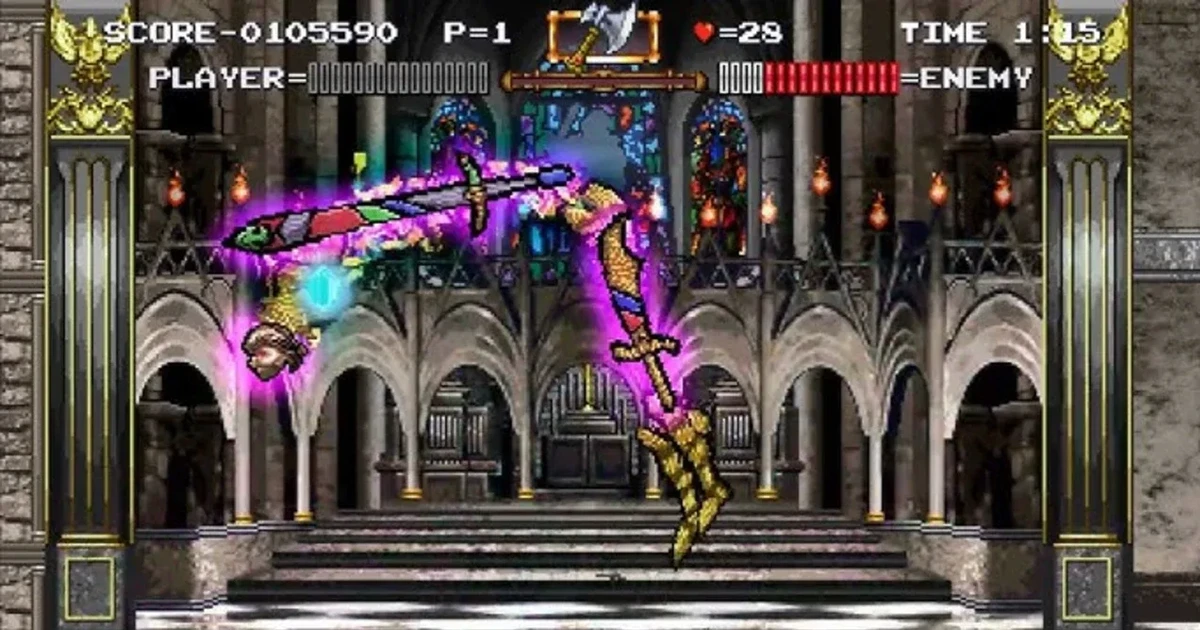
GAME INFORMATION
Game Title: Castlevania: Haunted Castle
Platform Played:PlayStation 5
Available Platforms:Nintendo Switch, PlayStation 5, Xbox Series X/S, PC via Steam
Media Type: Physical
Developer:Konami
Publisher:Konami
Genre:Action Platformer / Classic Castlevania
Release Year:2024
PLAY ENVIRONMENT
Playtime:6 hours
Completion Status:Completed
Difficulty:Normal
Graphics Mode:Default
Playthrough Type:Standard playthrough
Game Version:Castlevania Dominus Collection version
Controller Used:DualShock
Display Environment:1080p Monitor
QUICK VERDICT
Castlevania: Haunted Castle is a strange, harsh, and often unfair arcade interpretation of Castlevania. It is not the best game in the series, and it is certainly not the easiest game to recommend, but it has a gothic beauty that is hard to ignore. Its difficulty can be miserable, especially in the North American version, yet underneath the punishment there is a short, visually rich Castlevania adventure with strong music, memorable stages, and a certain stubborn charm.
It is a game I respect more than I enjoy. But after finally beating it, I also understand why it has remained so infamous.

PROS & CONS
pros
- Beautiful gothic arcade visuals
- Excellent music and sound design
- Strong atmosphere throughout
- Short enough to replay and learn
cons
- Stage one is far too punishing
- Final boss is underwhelming
- Some jumps and enemy placements feel unfair
STORY & NARRATIVE
Haunted Castle is an arcade spin on Castlevania, originally released by Konami in 1988. It was not the first arcade Castlevania game, as that honour belongs to Vs. Castlevania, a North American arcade version of the 1986 NES original. Haunted Castle, however, is not a port. It is a brand-new side-scrolling action platformer designed specifically for the arcade.
The story is simple, dramatic, and very Castlevania. Simon Belmont has just married his bride, Selena, when Dracula returns and kidnaps her during the wedding. Simon then sets off for the demon castle to rescue her.
It is not a deep story, but it works because it gives the game an immediate gothic purpose. There is something almost theatrical about the opening. A wedding. Dark clouds. Thunder. Dracula descending from the sky. A stolen bride. A lone Belmont walking into death. It feels like a horror stage play compressed into a few seconds.
Compared to later Castlevania games, Haunted Castle does not offer much character development or world-building. Simon is simply Simon. Dracula is simply evil. Selena is the person to be rescued. But for an arcade game, that simplicity is fine. It gives the player enough context without slowing the game down.
What matters more is the journey. The game quickly moves from village graveyards and catacombs into caverns, castle halls, banquet rooms, ramparts, and finally Dracula’s lair. The story is carried less by dialogue and more by visual progression. You are not reading Simon’s struggle. You are surviving it.
In that sense, Haunted Castle understands one of Castlevania’s oldest strengths: atmosphere can tell the story.
GAMEPLAY & SYSTEMS
At its core, Haunted Castle is a traditional action platformer. You move from left to right, fight monsters, avoid hazards, collect hearts, use sub-weapons, defeat bosses, and move closer to Dracula. On paper, this sounds very close to the original NES Castlevania. In practice, it feels much more brutal because of its arcade design.
The game is only six stages long, but those six stages are packed with damage, instant deaths, awkward jumps, and enemies that often feel placed to steal coins rather than test skill. This is the major difference between Haunted Castle and the better classic Castlevania games. In the best entries, death usually teaches you something. In Haunted Castle, death often feels like the game laughing at you.
Simon starts with his whip, which can later be upgraded into a ball and chain or sword. The weapons feel satisfying when they connect, especially the ball and chain, which has a heavy, nasty impact. Sub-weapons also return, including familiar options such as the cross and stopwatch. These can be very useful, especially against bosses, but hearts are not always easy to gather safely.
The structure is very arcade-focused. You have limited continues, and in some versions the game allows you to refill health by feeding in more credits. That makes sense for an arcade machine, but it also affects the balance. The game often feels like it was designed to hurt you early and often.
The first stage is the clearest example. You begin in a graveyard, fighting through enemies that already deal heavy damage. Then you reach a collapsing wall mini-boss that throws bricks at you while rain pours down. At first, this section feels almost impossible if you do not realise that you can whip the bricks out of the air. Once you understand that, it becomes much more manageable, but the game does very little to guide you.
After that, werewolf-like enemies leap from the trees with little warning. Then you deal with pillars, flames, bats, and finally the first boss, the Wicked Mermaid, who feels closer to Medusa in practice. Her snake pattern is awkward, and reaching her with enough health left can be harder than the fight itself.
The strange thing is that after this brutal opening, the game becomes more reasonable. It is still hard, but it starts to feel more like Castlevania hard rather than unfair arcade punishment. Stage two, stage three, and beyond all have their own challenges, but they are easier to understand with practice.
There are still some rotten moments. One section involving a winding staircase, a knight, and a leaping hunchback enemy is especially awkward because the controls do not make it easy to step off cleanly. Near the end, there is also an upward-scrolling section where the game pushes Simon past platforms that are very difficult to avoid. It feels clumsy rather than exciting.
Bosses are mixed. Some are interesting, like the bone dragon or stained-glass soldier, while others are surprisingly easy. Dracula himself is visually imposing but mechanically underwhelming. After all the punishment it takes to reach him, the final battle ends far more quickly than expected.
Haunted Castle is not refined. It is not smooth. But there is something addictive about learning its harsh patterns and slowly pushing further. It sits on the line between genuine challenge and stubborn coin-op cruelty.
WORLD DESIGN
Haunted Castle follows a familiar Castlevania structure, but its locations have a strong visual identity. The game begins in a graveyard outside the village, then moves through catacombs, foggy landscapes, fiery caverns, castle interiors, crumbling ramparts, and finally Dracula’s domain.
The level design itself can be uneven. Some areas are straightforward and enjoyable. Others rely too heavily on surprise damage, awkward platforming, or enemies appearing in uncomfortable positions. It does not always feel fair, especially during the first stage and the upward-scrolling section near the end.
However, the actual world has a strong sense of movement. Each stage feels like Simon is getting closer to something darker. The graveyard gives way to underground horror. The caverns lead into the castle. The castle becomes more decadent, corrupted, and theatrical as you progress.
One of the best parts of Haunted Castle is how much it feels like a haunted journey. You are not simply moving through generic levels. You are passing through a gothic nightmare built from graves, fire, stone, portraits, chandeliers, monsters, and decay.
The game is short, but visually it feels full.
VISUAL DESIGN
This is where Haunted Castle shines brightest.
The game’s reputation is often built around its difficulty, but its visual design deserves much more attention. As an arcade game, Haunted Castle takes advantage of stronger hardware than the NES titles, and the result is a much richer version of classic Castlevania horror.
The opening graveyard is beautiful. A blazing sunset glows behind the mountains, casting orange light across the village and the crooked gravestones. As you move forward, the sky shifts, the atmosphere becomes darker, and rain begins to fall. It immediately creates a powerful gothic mood.
Stage two is even better. The foggy view of Dracula’s castle in the distance is primitive by modern standards, but still effective. Later, the game moves underground into fiery caverns filled with supernatural roots and lava. My favourite visual moment comes in the second half of the stage, where Simon crosses petrified tree stumps above a shining deadly pool, with a flaming volcanic sky behind him. It is harsh, dangerous, and strangely beautiful.
The castle interiors are also excellent. Haunted Castle captures the grand, corrupt feeling of Dracula’s home. There are candlelit halls, decadent rooms, old portraits, and crumbling architecture. One standout moment in stage three has Simon walking past a huge portrait crying blood. It is a small detail, but it captures the entire mood of Castlevania in one image.
The character sprites are also more detailed than earlier console entries. Simon’s outfit has extra shading and highlights, and some enemies have a rough arcade charm. The animation is not always elegant, but the extra visual detail gives the game a heavier, more physical feeling.
Haunted Castle may be cruel, but it is rarely boring to look at.
SOUND & MUSIC
The music is one of Haunted Castle’s greatest strengths. Castlevania has always been known for excellent soundtracks, and this game continues that tradition with a heavier arcade sound.
The basslines have real weight. The melodies have a sharp gothic shimmer. The tracks build tension while still carrying that unmistakable Castlevania energy. The music feels grand, dark, and alive.
The use of Bloody Tears is especially memorable. Hearing that familiar theme inside a decaying banquet room, near a blood-crying portrait, is one of the game’s best moments. It connects Haunted Castle to the wider series while still letting it have its own arcade identity.
The sound effects are also strong. The whip and ball and chain have a nasty impact. Thunder, enemy sounds, and magical effects all have a thick, booming quality. Some monster sounds are properly guttural, adding to the horror atmosphere.
When the music, visuals, and sound effects come together, Haunted Castle can feel incredible. For a few seconds, you may be standing in a candlelit hall, swinging a brutal weapon at undead creatures while gothic music pounds in the background, and it feels like pure arcade Castlevania.
Then you die again.
But for those few seconds, it is wonderful.
PERFORMANCE
As part of the Konami Arcade Classics Anniversary Collection, Haunted Castle runs smoothly and presents the arcade game well. I did not have any major performance problems during my time with it.
The more important issue is not technical performance, but game feel. Simon is responsive enough for basic movement and combat, but some sections make the controls feel stiff or awkward. This is especially noticeable when climbing stairs, stepping onto platforms, or reacting to sudden enemy attacks.
That stiffness is part of classic Castlevania to some extent, but in Haunted Castle the level design is not always careful enough to support it. When the game asks for precision, the controls do not always feel precise. When enemies appear suddenly, Simon’s movement does not always feel quick enough to respond.
So while the game performs fine technically, its design sometimes clashes with its control style.
DIFFICULTY
Difficulty Rating
8 / 10
Haunted Castle is infamous for its difficulty, and that reputation is mostly deserved. However, the exact experience depends heavily on which version you play.
The North American version is extremely punishing. Enemy damage is brutal, continues are limited, and the first stage alone can feel like a wall. For a long time, I mostly replayed the first half of stage one again and again. It was not just difficult. It was exhausting.
The Japanese version is more forgiving. Enemy damage, checkpointing, and continues make the game feel closer to something you can actually learn and finish. It is still hard, but it becomes hard in a more enjoyable way.
What surprised me most is that Haunted Castle’s worst difficulty is mostly front-loaded. Stage one is so punishing that it makes the entire game seem worse than it really is. Once you understand the opening stage and move beyond it, the rest of the game becomes much more balanced, apart from a few ugly spikes.
That does not mean the game is fair. It often is not. Some enemies appear too suddenly. Some jumps are too risky. Some sections feel designed to drain health rather than test mastery. But there is also a strange satisfaction in gradually learning its cruelty.
It is not a game I would recommend to someone looking for a fair challenge. It is a game for players who enjoy stubbornness, repetition, and the feeling of slowly breaking through something hostile.
REPLAY VALUE
Haunted Castle is short, so replay value comes mostly from mastery. Once you know the stages, it becomes easier to push through the game quickly. The Japanese version in particular is replayable because it feels more balanced and less punishing.
The North American version is harder to recommend for repeat play unless you specifically enjoy arcade punishment. It can become fun once you understand its tricks, but reaching that point takes patience.
There is also some historical value. Haunted Castle is worth playing if you are interested in Castlevania’s evolution, Konami’s arcade work, or strange side entries in famous series. It is not essential in the same way as Castlevania III, Super Castlevania IV, Rondo of Blood, or Symphony of the Night, but it is an interesting piece of the series’ history.
For normal players, one clear may be enough. For Castlevania fans, it is worth experiencing at least once.
RECOMMENDED FOR
Recommended for:
- Players interested in arcade history
- Fans of gothic visuals and strong game music
- Players who enjoy difficult retro games
- Castlevania fans who have played the main classics
Not recommended for:
- Castlevania newcomers
- Players who dislike unfair difficulty
- Anyone looking for smooth modern controls
PERSONAL EXPERIENCE
My time with Haunted Castle was split between stubbornness and genuine enjoyment.
At first, I mostly hated it. The North American version on normal difficulty felt absurd. Stage one alone was enough to make the game feel broken. I kept dying in the graveyard, at the wall, to the bats, to the flames, to Medusa, and sometimes to mistakes that did not feel entirely like my fault.
But slowly, the game started to make sense. I learned that the bricks could be whipped. I learned where enemies appeared. I learned how to survive the opening with more health. I learned that repetition was not always pointless.
Then I tried the Japanese version, and the whole game opened up. It was still difficult, but it felt possible. I could finally see beyond the reputation. I could appreciate the backgrounds, the music, the atmosphere, and the strange arcade rhythm of it all.
I still do not think Haunted Castle is a great game. It is too uneven, too punishing, and too clumsy in places. But I am glad I finished it. There is a certain quiet satisfaction in beating something that once felt impossible.
That is the strange thing about difficult games. Sometimes you keep playing because you are enjoying yourself. Sometimes you keep playing because you refuse to let the game win. Haunted Castle gave me both feelings.
FINAL VERDICT
Castlevania: Haunted Castle is not one of the best Castlevania games, but it is one of the most interesting. It is beautiful, harsh, uneven, atmospheric, frustrating, and memorable. Its visuals and music show Konami’s gothic style at full arcade strength, while its difficulty shows the worst side of coin-op design.
The first stage is far too punishing, especially in the North American version, and some later sections feel awkward rather than fair. Yet once you push past the opening wall, there is a better game underneath than its reputation suggests. The Japanese version especially reveals a short but enjoyable arcade Castlevania with strong atmosphere and some excellent presentation.
Would I recommend it to everyone? No. If you are new to Castlevania, play Super Castlevania IV, Rondo of Blood, or Symphony of the Night first. Those games show the series at its best.
But if you already love Castlevania and want to see one of its strangest arcade shadows, Haunted Castle is worth playing. Not because it is perfect. Not because it is fair. But because hidden inside all the punishment is a gothic little nightmare with enough beauty to make the suffering memorable.
It is Castlevania at its most stubborn.
And sometimes, that is enough.