
GAME INFORMATION
Game Title: Final Fantasy Pixel Remaster
Platform Played:PlayStation 4
Available Platforms:PlayStation 4, Nintendo Switch, PC, Mobile
Media Type: Physical
Developer:Square Enix
Publisher:Square Enix
Genre:Turn-Based JRPG
Release Year:2021
PLAY ENVIRONMENT
Playtime:20 hours
Completion Status:Platinumed
Difficulty:Default
Graphics Mode:Default
Playthrough Type:100% Playthrough
Game Version: Latest Version
Controller Used:DualShock 4
Display Environment:1080p Monitor
QUICK VERDICT
Final Fantasy I Pixel Remaster is a careful, respectful, and highly playable version of one of the most important JRPGs ever made. It does not try to completely reinvent the original game. Instead, it cleans it, restores it, improves its flow, and makes it far easier to enjoy today.
The visuals are bright and charming, the orchestral music gives the adventure new life, and the modern quality-of-life options make the experience more accessible without removing the soul of the original. Some older design choices still remain, especially around the magic system and simple story structure, but this version gives Final Fantasy I the best chance to be appreciated by a modern audience.
It may not be the best Final Fantasy game, but it is one of the most important. For players interested in Japanese RPG history, classic turn-based design, or the roots of Square Enix’s most famous series, this is a very easy recommendation.

PROS & CONS
pros
- Beautifully updated pixel art
- Excellent orchestral soundtrack
- Option to switch between modern and original music
- Strong CRT filter
- Faster and smoother combat
- Improved menus and user interface
- Autosave makes the game more forgiving
-
Bestiary, gallery, and music player add value
cons
- Story is still very simple
- Party balance can still feel uneven
- Not all players will enjoy the older structure
- Magic system may feel restrictive
STORY & NARRATIVE
Final Fantasy I has a very simple story, but it is important to understand the time it came from. This is not a modern JRPG filled with long cutscenes, complex character arcs, or emotional dialogue. Instead, it is a classic fantasy quest built around a clear and traditional idea: four Warriors of Light must restore balance to a world falling into darkness.
The story works because of its simplicity. There is an ancient evil, four elemental forces, a world in danger, and a group of heroes chosen to save it. By modern standards, the writing is light, and the individual party members do not have their own personalities or personal storylines. However, this also gives the player space to imagine their own party and create their own connection to the journey.
This is one reason why the improved character naming system matters more than it may first appear. In the original NES version, character names were extremely limited. Later versions expanded this, and the Pixel Remaster improves it again. Being able to name your party properly adds a small but meaningful personal touch. Many players will name their characters after friends, family members, favourite anime characters, film characters, or personal creations. In a game where the heroes are mostly blank slates, this small freedom helps make the adventure feel more personal.
The narrative is not the main reason to play Final Fantasy I today. It is more of a foundation. It shows the early shape of many ideas that would later become central to the series: crystals, elemental powers, chosen heroes, airships, world maps, and a journey that grows from a small kingdom into something much larger.
For Japanese RPG fans, this gives the game historical value. It is not just a story to experience. It is a starting point. You can see the roots of a genre that would later give us games like Final Fantasy IV, VI, VII, IX, X, and many others.
GAMEPLAY & SYSTEMS
The most important question with any older RPG remake is simple: does the gameplay still hold up?
In the case of Final Fantasy I Pixel Remaster, the answer is mostly yes. The core game remains traditional and simple. You create a party of four characters, choose their classes, explore towns, travel across a world map, enter dungeons, fight random battles, gain experience, earn gil, buy equipment, learn magic, and slowly push further into the world.
It is a structure that many JRPG players will understand immediately. What makes this version successful is not that it changes the structure, but that it improves the pace.
The original NES version could feel slow and frustrating in combat. One of the most famous issues was how attacks were handled after an enemy had already been defeated. If multiple party members were assigned to attack the same enemy, and that enemy was killed before everyone had taken their turn, the remaining characters would still try to attack the empty space. This meant wasted turns, slower battles, and unnecessary frustration.
Thankfully, this has been corrected in later versions, including the Pixel Remaster. Characters now redirect their attacks properly, which makes battles feel much smoother and more logical.
The attack rate also feels more generous, making early combat less tiring. This matters because Final Fantasy I still involves a lot of random battles. Grinding is part of the experience, especially if you are playing without boosters. If combat felt slow, the whole game would suffer. Instead, the Pixel Remaster keeps battles quick and readable.
The party system remains one of the game’s strongest features. Choosing your team at the start gives the player immediate control over the type of experience they want. A balanced party with physical attackers, white magic, and black magic will give you flexibility. A more physical party may make normal battles easier but reduce your healing options. A magic-heavy party may offer power and utility, but it can be more fragile and resource-dependent.
This choice gives the game replay value, but it can also be slightly intimidating for new players. The game does not explain every long-term consequence of your party setup. Still, this is part of the old-school charm. Final Fantasy I asks you to commit to a party and learn through the journey.
The magic system is one area where the Pixel Remaster may divide players. Rather than using the more modern MP system seen in some previous remakes, where spells cost different amounts of a shared MP pool, this version returns closer to the original level-based magic system. Magic users have a limited number of spell uses for each magic level.
This system has its own identity. It makes magic feel valuable and limited. You cannot simply cast your strongest spells whenever you want. You have to plan carefully, manage resources, and think about whether a spell is worth using now or saving for later.
However, it can also feel restrictive. In tougher areas, especially when healing and defensive magic become important, the system may make you wish for the more flexible MP system from earlier remakes. It can sometimes encourage you to rely more heavily on items or physical damage, depending on your party.
Still, the overall gameplay is enjoyable. It is simple, focused, and clear. It does not have the depth of later Final Fantasy games, but it has a clean rhythm that still works.
WORLD DESIGN
The world design of Final Fantasy I is traditional but effective. You begin in a small, limited area, and gradually the world opens up as you gain new tools, defeat major enemies, and unlock new ways to travel.
This sense of expansion is one of the game’s strongest qualities. At first, the world feels small and dangerous. Then you begin crossing seas, reaching new towns, entering new dungeons, and eventually travelling by airship. There is a simple but satisfying feeling of progression.
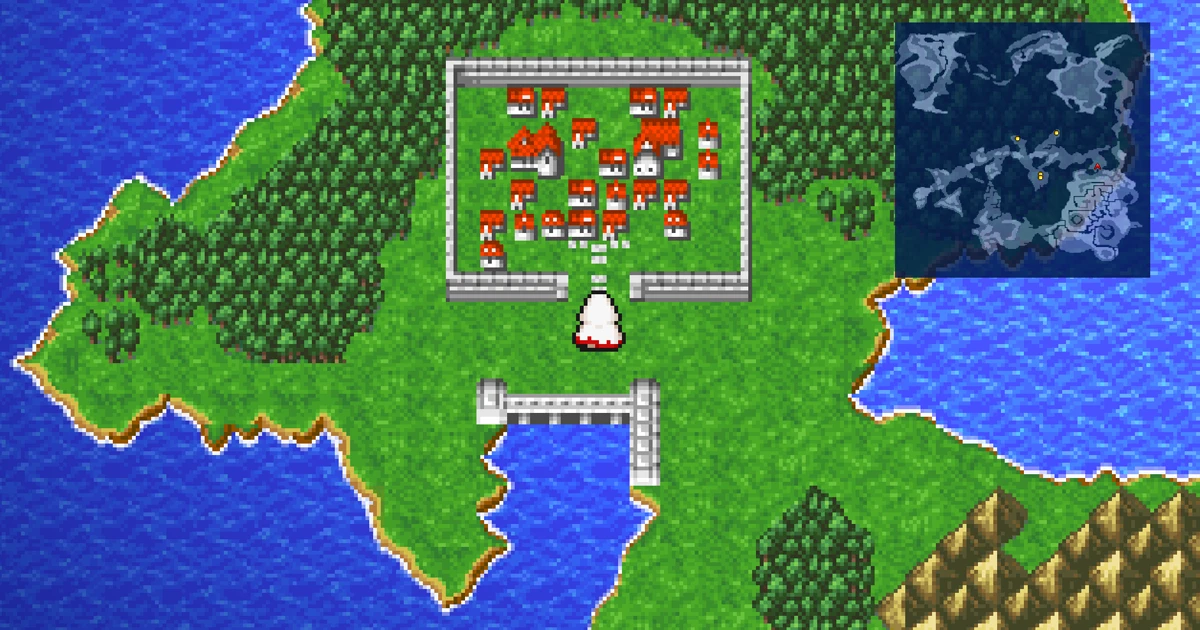
The Pixel Remaster helps the world feel more alive through its updated visuals. Towns, castles, caves, shrines, and the world map all benefit from the new art style. The world map in particular has a pseudo-3D effect that gives it more depth while still respecting the look of a classic pixel RPG.
The dungeons are straightforward, but they still carry that old RPG sense of danger. You need to think about resources, healing, spell uses, and whether you should push forward or return to town. This creates a steady tension. It is not as complex as modern dungeon design, but it has a clear purpose.
For modern players, some of the world design may feel basic. Towns are simple, NPC dialogue is limited, and objectives are sometimes less guided than newer games. But for players who enjoy classic JRPG structure, this simplicity can be relaxing. The game gives you a world, a goal, and the space to explore at your own pace.
VISUAL DESIGN
The visual upgrade is one of the Pixel Remaster’s greatest strengths.
Compared to the original 8-bit NES version, this version gives the game a much softer, cleaner, and more expressive look. Characters have more personality, monsters are more detailed, and environments feel warmer and more alive. It still looks like a pixel RPG, but it no longer feels visually harsh or limited.
The updated graphics do a good job of respecting the original style while making the game more comfortable to play on modern screens. The colours are bright without being overwhelming, and the character sprites are charming without becoming too modern or disconnected from the source material.
The font options are also welcome. The Pixel Remaster allows players to choose between a more traditional pixel-style font and a cleaner modern font. This may sound like a small option, but it matters. Readability is important in an RPG, especially for players with eyesight concerns or those playing on different display sizes. The modern font makes the game easier to read, while the pixel font is there for players who want a more classic feel.
The CRT filter is another excellent addition. Many retro collections include CRT filters, but they often feel too heavy, blurry, or artificial. Here, the effect is tasteful and atmospheric. It gives the game a softer 80s-inspired feel without ruining readability. For players who enjoy retro presentation, it may become the preferred way to play.
Overall, the visual design is handled with care. It does not try to turn Final Fantasy I into something completely new. It simply presents the game in a way that feels clean, warm, and respectful.
SOUND & MUSIC
The soundtrack is another major highlight.
The Pixel Remaster includes new orchestral arrangements of the original music, and these arrangements give the adventure a much grander feeling. The music feels fuller, clearer, and more emotional, while still keeping the spirit of the original compositions.
For players who enjoy retro audio, the option to switch between the new soundtrack and the original NES-style music is a welcome feature. Choice is important in a remaster, especially when dealing with a game that has historical importance. Some players will want the authentic old sound. Others will prefer the richer modern arrangement.
Personally, the orchestral music feels like the stronger option for most modern playthroughs. It adds scale and beauty to the journey, especially on the world map and during important moments. The original music has value, but the new arrangements make the game easier to enjoy for long sessions.
It is also good that the remaster does not go too far with new audio. There are no voiceovers or unnecessary dramatic additions. This is the right choice. Final Fantasy I has a quiet, classic atmosphere, and adding too much could have damaged that feeling. The simple sound effects and improved music are enough.
The result is a soundtrack that feels both nostalgic and fresh. It honours the past while making the game more pleasant to experience today.
PERFORMANCE
Final Fantasy I Pixel Remaster runs smoothly and comfortably. The game is not technically demanding, so the most important performance points are responsiveness, readability, menu speed, and general stability.
Menus are clean and easy to navigate. Combat moves quickly. Transitions are smooth. The autosave system is a very useful addition, especially for players who may forget to save before a boss or difficult dungeon section.
The user interface is also much improved compared to older versions. It is easier to understand equipment, items, magic, and party information. This makes the experience more welcoming for new players while still keeping the classic structure intact.
There is very little to criticise from a performance perspective. This version feels polished, stable, and comfortable.
DIFFICULTY
Difficulty Rating
4 / 10
Final Fantasy I can still offer challenge, especially for players unfamiliar with older JRPGs. Resource management, random encounters, limited magic uses, and party composition all matter. If you enter a dungeon underprepared, you may struggle.
However, the Pixel Remaster includes several options that make the game much more accessible. Players can adjust random encounter rates and increase the amount of gil and experience gained from battles. These features are very helpful for players who want a more relaxed experience or who are mainly interested in seeing the game’s world and history.
Some experienced players may dislike these options, but their inclusion is a good thing. They do not remove the original experience for those who want it. They simply allow more people to enjoy the game in a way that suits them.
This is especially important for a game like Final Fantasy I. As the beginning of such an important series, it should be approachable. The Pixel Remaster understands this and gives players more control over their experience.
REPLAY VALUE
Final Fantasy I has solid replay value because of its party creation system. Different class combinations can change the feel of the game significantly. A balanced party, a physical-heavy party, or a magic-focused party can each create a different rhythm.
The bestiary, music player, and art gallery also add value beyond the main story. The bestiary is especially useful for players who enjoy completion, statistics, and understanding enemy strengths and weaknesses.
This is not a huge game by modern standards, but that works in its favour. It is short enough to replay without feeling like a massive commitment. For players interested in JRPG history, it can easily become a game worth returning to.
RECOMMENDED FOR
Recommended for:
- Players interested in Japanese RPG history
- Fans of classic turn-based combat
- Players who enjoy simple fantasy adventures
- Beginners who want an accessible way to try an old-school JRPG
- Final Fantasy fans who want to understand the beginning of the series
Not recommended for:
- Players who need deep character writing
- Players who dislike random encounters
- Players who prefer action combat
- Players who dislike grinding or older RPG structure
- Players expecting the complexity of later Final Fantasy games
PERSONAL EXPERIENCE
What stands out most about Final Fantasy I Pixel Remaster is how respectful it feels. It does not treat the original game as something outdated that needs to be replaced. Instead, it treats it as something important that deserves to be preserved carefully.
The improved visuals make the world more pleasant to explore. The CRT filter gives the game a beautiful retro atmosphere. The orchestral soundtrack adds emotion and scale without overwhelming the original tone. The improved combat flow makes a major difference, especially compared to the more frustrating parts of the NES version.
The return to the older magic system may not be ideal for everyone. I personally prefer the more modern MP system from earlier remakes, as it gives magic users more flexibility in difficult battles. However, I understand why the Pixel Remaster chose to stay closer to the original design. It gives the game a stronger historical identity, even if it can feel restrictive at times.
The accessibility options are also a major positive. Being able to adjust encounters, gil, and experience makes the game easier to recommend to new players. It respects both types of audience: those who want the old challenge, and those who simply want to experience the first Final Fantasy without unnecessary frustration.
This balance is what makes the Pixel Remaster work. It is not just a museum piece. It is still a playable, enjoyable RPG.
FINAL VERDICT
Final Fantasy I Pixel Remaster is one of the best ways to experience the beginning of the Final Fantasy series. It keeps the structure, spirit, and identity of the original game while improving the areas that most needed attention.
The graphics are charming, the music is excellent, the user interface is clean, and the quality-of-life features make the game far more welcoming than many older versions. Combat is faster, exploration is smoother, and the optional boosters allow players to shape the experience around their own patience and skill level.
It is important to remember that this is still Final Fantasy I. The story is simple, the characters are mostly blank slates, and the systems are not as deep as later entries. Players expecting the emotional drama of Final Fantasy VII, the character focus of Final Fantasy X, or the mechanical depth of later RPGs may find it basic.
But judged as a restored classic, Final Fantasy I Pixel Remaster succeeds beautifully. It gives modern players a clean and respectful way to experience a landmark Japanese RPG, while also preserving the charm and structure that made the original so important.
It may not be the greatest Final Fantasy game, but it is one of the most meaningful. It is the first step of a long road, and this version makes that road easier, warmer, and more enjoyable to walk.
For RPG fans, Final Fantasy fans, and anyone interested in the history of Japanese games, Final Fantasy I Pixel Remaster is absolutely worth playing.