
GAME INFORMATION
Game Title: Asura’s Wrath
Platform Played:PlayStation 3
Available Platforms:PlayStation 3, Xbox 360
Media Type: Physical
Developer:CyberConnect2
Publisher:Capcom
Genre:Cinematic Action, Interactive Anime, Quick-Time Event Action
Release Year:2012
PLAY ENVIRONMENT
Playtime:10 hours
Completion Status:Completed
Difficulty:Hard
Graphics Mode:Default
Playthrough Type:Standard story playthrough
Game Version: Latest Version
Controller Used:DualShock 3
Display Environment:1080p Monitor
QUICK VERDICT
Asura’s Wrath is one of the most unique games of the PlayStation 3 era. It is less a traditional action game and more an interactive anime, built around rage, mythology, impossible battles, and visual spectacle. At its best, it feels like watching a lost high-budget anime film where every scene is trying to outdo the last.
As a pure game, however, it is much harder to recommend without warning. There is not a huge amount of actual gameplay here. Much of the experience is made up of cutscenes, quick-time events, short combat encounters, and cinematic transitions. For some players, that will feel exciting and fresh. For others, it may feel too passive.
Still, Asura’s Wrath has something many safer games do not: a clear identity. It knows exactly what it wants to be. It wants to be loud, emotional, dramatic, strange, stylish, and completely excessive. For players who enjoy Japanese action, anime storytelling, mythological imagery, and experimental game design, this is absolutely worth experiencing at least once.
It is not a perfect game, but it is a memorable one.

PROS & CONS
pros
- One of the most unique cinematic action games of its generation
- Strong use of Japanese mythological and science-fiction imagery
- Incredible visual direction and anime-style presentation
- Short, focused, and easy to play through
- Asura himself is a powerful and memorable protagonist
- Excellent episode structure that makes the game feel like an anime box set
- Some of the most absurd and exciting set pieces in gaming
cons
- Very light on actual gameplay
- Heavy reliance on cutscenes and quick-time events
- Limited replay value once the story has been seen
- Repetition in enemy encounters and boss patterns
STORY & NARRATIVE
The story of Asura’s Wrath follows Asura, a demigod warrior who is betrayed by the other deities he once fought beside. His wife is killed, his daughter is taken, and he is cast down from the heavens. Thousands of years later, Asura returns through the force of his own anger. He does not come back as a calm hero seeking justice through noble words. He comes back as a father, a husband, and a broken weapon of rage.
That simplicity is what gives the story its power.
At its core, this is not a complicated narrative. It is a revenge story. A father wants his daughter back. A man betrayed by the gods wants answers. A warrior who has lost everything turns his pain into violence. But Asura’s Wrath presents this simple emotional core with such overwhelming scale that it becomes something unforgettable.
The story spans thousands of years and moves between Earth, space, the heavens, and impossible battlegrounds. Characters speak with the seriousness of ancient myth, while the action itself often reaches the energy of extreme shonen anime. A single punch can send someone flying across the planet. A sword can stretch across space. A god can become a weapon of light. The world is not built for realism. It is built for feeling.
This is where the game feels very Japanese in spirit. It takes emotion and turns it into form. Rage becomes power. Grief becomes movement. Defiance becomes combat. Asura’s body is constantly destroyed, rebuilt, pushed beyond its limits, and driven forward by one thing: he refuses to stop.
There is something almost Buddhist in the way the game deals with suffering, even if it does so through screaming, explosions, and planet-sized violence. Asura is trapped in a cycle of anger, death, rebirth, and conflict. His wrath gives him strength, but it also consumes him. The game is not subtle about this, but subtlety is not what it is aiming for. It is aiming for impact.
The episode structure also helps the story feel distinct. Each chapter plays like an anime episode, complete with opening-style presentation, title cards, illustrated interludes, and previews of what comes next. This gives the game a strong rhythm. It feels less like progressing through levels and more like moving through a dramatic animated series.
The story can become ridiculous, especially near the end, but that is part of its identity. Asura’s Wrath is not afraid to be excessive. It does not apologise for being strange. It commits fully to its own world, and that commitment is what makes it work.
GAMEPLAY & SYSTEMS
The biggest weakness of Asura’s Wrath is also the thing that defines it: there is not much traditional gameplay.
This is not a deep action game. It is not a character action game like Devil May Cry, Bayonetta, or Ninja Gaiden. It is not built around long combos, technical mastery, or complex enemy design. Instead, it uses gameplay as a way to support cinematic scenes.
Most episodes include a mixture of short combat sections, on-rails shooting, quick-time events, and long cutscenes. Sometimes you are fighting groups of enemies in small arenas. Sometimes you are shooting targets while flying through space. Sometimes you are pressing buttons during a dramatic clash. Sometimes you are simply watching the story unfold.
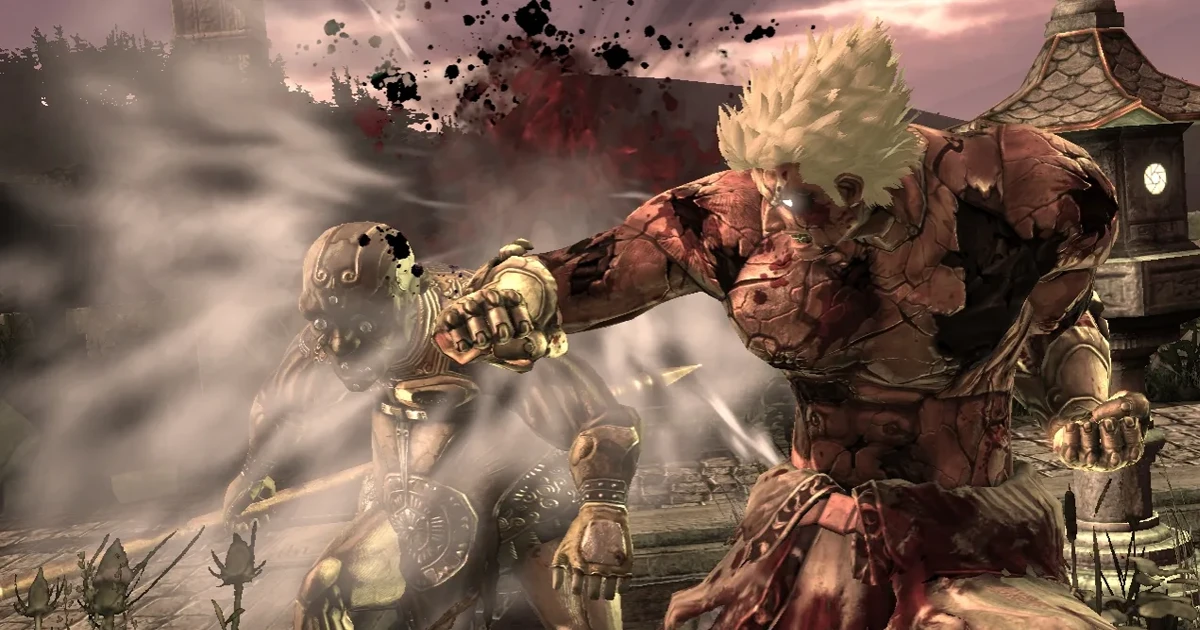
The combat itself is simple but satisfying. Asura has light attacks, heavy attacks, ranged attacks, counters, and special finishers. The main goal during combat is to build the Burst gauge. Once the gauge is full, Asura can trigger a cinematic moment that moves the story forward. This is a smart idea because it connects the mechanics directly to the theme. You are not just reducing enemy health bars. You are building rage until Asura can force the world to move.
That connection between gameplay and emotion is one of the best things about the game. Asura is not a graceful fighter. He does not feel elegant or controlled. He feels like a storm. The simple combat suits him because he is not meant to be a technical swordsman or a stylish demon hunter. He is a furious demigod who solves problems by punching through them.
The issue is that the game rarely lets these systems develop. Just when the combat starts to feel enjoyable, the episode often moves back into cutscene or QTE territory. There are moments where you can see the outline of a stronger action game underneath the cinematic design, but it never fully becomes that.
The quick-time events are also a mixed part of the experience. They look impressive and help the player feel connected to the action, but they do not always carry much consequence. Failing a prompt usually affects your rating rather than changing the scene in a meaningful way. Because of this, the interactivity can sometimes feel surface-level.
Still, it would be unfair to judge Asura’s Wrath only by the standards of a traditional action game. It is trying to be something else. Its gameplay is not the main course. It is the thread that ties the cinematic experience together.
Whether that works depends on the player.
If you want deep combat, long missions, builds, upgrades, exploration, or mechanical mastery, this may disappoint you. If you want an intense interactive anime where the gameplay exists to make the spectacle feel more personal, then it succeeds.
WORLD DESIGN
The world of Asura’s Wrath is one of its strongest elements, not because it is explorable, but because it is visually and conceptually unforgettable.
This is not an open world. It is not a game about wandering through towns, collecting lore items, or slowly discovering history through environmental detail. The world exists mainly through cutscenes, battlefields, and dramatic imagery. But what imagery it is.
The game blends Japanese and Asian mythological influence with science-fiction technology, cosmic scale, and anime exaggeration. The gods are not simple divine beings in robes. They are part religious icon, part military commander, part machine-age ruler. Massive fleets fill the sky. Divine weapons fire like orbital cannons. Buddha-like figures appear as engines of destruction. The result is strange, beautiful, and completely its own.
This combination of spirituality and machinery gives the world a strong identity. It feels ancient and futuristic at the same time. The world is full of sacred shapes, enormous statues, glowing energy, mechanical weapons, and impossible bodies. It has the feeling of myth being retold through the language of anime and video games.
The game also uses scale extremely well. Many games try to feel epic, but Asura’s Wrath is one of the few that truly commits to it. Battles do not just happen in arenas. They happen across continents, in space, on the moon, and against enemies so large that they stop feeling like characters and start feeling like natural disasters.
There is not much freedom in this world, but there is a lot of presence. Every location exists to frame a moment. Every backdrop exists to make Asura’s anger feel bigger.
For a game so short, its world leaves a strong impression.
VISUAL DESIGN
Visually, Asura’s Wrath is outstanding.
Even many years after release, its art direction remains powerful because it does not rely only on technical realism. Instead, it relies on style, composition, animation, and identity. The game looks like a high-energy anime filtered through mythological painting, comic-book linework, and science-fiction design.
Character designs are bold and instantly readable. Asura himself is simple but effective: scarred, furious, muscular, and always on the edge of breaking apart. His body tells the story before he speaks. Yasha, by contrast, is calm, stylish, elegant, and controlled. The visual difference between them makes their rivalry more interesting.
The gods and enemies are equally striking. Many designs use exaggerated forms, multiple arms, masks, glowing patterns, and divine imagery. There is a strong sense of theatricality. Characters do not just enter a scene. They arrive like legends.
The cutscene direction is one of the game’s greatest achievements. Camera angles are dramatic without feeling random. Impacts feel heavy. Explosions feel enormous. Every major scene is staged for maximum emotional and visual force. The game knows how to frame a punch, a scream, a stare, or a moment of silence before violence.
The illustrated episode breaks are also beautiful. They give the game the feeling of a premium anime production and help separate each chapter with a sense of ritual. This is one of the details that makes the presentation feel so complete. It is not just a game with anime influence. It is structured like anime.
For players who love Japanese visual design, Asura’s Wrath is a joy to look at. It has the confidence of a work made by people who deeply understand manga, anime, and dramatic action.
SOUND & MUSIC
The sound design in Asura’s Wrath is built around intensity. Every punch, explosion, scream, and energy blast is given weight. The game wants you to feel impact, and the audio helps sell that feeling.
The voice acting is dramatic and often extreme, but that suits the tone. This is not a quiet, grounded story. Characters shout their beliefs at each other while destroying mountains and fighting in space. The performances match the scale of the world.
Asura’s voice performance is especially important. His rage could easily become one-note, but the best moments show pain underneath the anger. He is not angry because he enjoys violence. He is angry because everything he loved was taken from him. The performance carries that emotional weight well.
The music supports the mythic tone of the game, often blending orchestral drama with the energy of anime action. It rises during huge battles, softens during emotional moments, and helps each episode feel like part of a larger animated saga.
The soundtrack may not be as instantly memorable as the visuals, but it works well within the experience. It gives the game scale, emotion, and momentum.
PERFORMANCE
On PlayStation 3, Asura’s Wrath performs well enough for the type of game it is. Because so much of the experience is cinematic, the most important thing is that scenes maintain their impact and flow. For the most part, they do.
The game is not a technical showcase in the modern sense, but its strong art direction helps it age well. Some textures, effects, and models show their age now, but the overall presentation still holds up because the visual identity is so clear.
During combat and on-rails sections, the game remains playable and responsive. There may be moments where the scale of the action is more impressive than the technical performance, but it rarely damages the experience.
The main thing to understand is that Asura’s Wrath succeeds more through direction than raw graphical power. It is not impressive because it looks realistic. It is impressive because it knows exactly how to use image, motion, and sound to create feeling.
DIFFICULTY
Difficulty Rating
5 / 10
Asura’s Wrath is not a very difficult game for most players. The combat is simple, the structure is linear, and the game is more focused on spectacle than punishment. There are harder moments, especially during boss fights or higher difficulty replays, but this is not a game built around mastery in the same way as a pure action title.
The ranking system gives players something to improve if they want better scores, but the main story can be enjoyed without needing high-level skill. This makes the game accessible, especially for players who are more interested in story and presentation than technical action gameplay.
The challenge is less about survival and more about rhythm. Learning when to attack, counter, dodge, and trigger Burst mode gives the combat some satisfaction, but the game rarely pushes the player too far.
For some, this will be a positive. For others, especially action game fans, it may feel too light.
REPLAY VALUE
Replay value is limited.
The episode structure makes it easy to revisit specific chapters, and players can return for better rankings or higher difficulty clears. However, because so much of the game depends on surprise and spectacle, the second playthrough naturally loses some impact.
Once you have seen the biggest scenes, the main reason to replay would be completion, trophies, rankings, or personal love for the game’s style. The actual gameplay does not have enough depth to carry repeated playthroughs on its own.
The short runtime helps in one sense because the game is easy to revisit. But it also makes the original full-price value harder to defend. At around six hours, with much of that time spent watching cutscenes, Asura’s Wrath can feel thin as a traditional game.
Today, this matters less if you can find it for a reasonable price. As a lower-cost physical pickup or a curiosity from the PS3 era, it is much easier to recommend. At launch price, the value would have been much more questionable.
RECOMMENDED FOR
Recommended for:
- Players who love anime-style storytelling
- Fans of Japanese action, mythology, and visual spectacle
- Players interested in unusual or experimental games
- Anyone looking for something truly different from the PS3 era
- Fans of CyberConnect2’s cinematic style
Not recommended for:
- Players who want deep combat systems
- Players who dislike quick-time events
- Players who prefer gameplay over cutscenes
- Anyone who dislikes extremely over-the-top anime storytelling
PERSONAL EXPERIENCE
I admire Asura’s Wrath because it has bravery.
Many games are content to follow safe structures. They offer familiar combat, familiar progression, familiar levels, and familiar pacing. Asura’s Wrath does not feel like that. It feels like a studio trying to create a new kind of interactive anime, even if the result is not perfect as a game.
That is what makes it so interesting to look back on.
It is easy to criticise Asura’s Wrath for being too light on gameplay, and that criticism is fair. There were many moments where I wanted more control, more combat, more systems, and more reasons to actively play. The game often asks the player to watch rather than act. In a medium built around interaction, that is a serious weakness.
But I also cannot deny how memorable it is.
There are scenes in Asura’s Wrath that stay in your mind because very few games would even attempt them. It has a kind of creative madness that feels rare. It turns rage into art. It turns grief into spectacle. It turns a father’s pain into a cosmic battle against gods.
For Japanese game fans, there is something special here. It carries the energy of anime, manga, tokusatsu, mythology, and arcade-era exaggeration. It does not hide its influences. It celebrates them. It understands that games do not always have to be realistic, restrained, or system-heavy to be valuable. Sometimes, a game can be remembered because it made you feel something huge.
That is the strength of Asura’s Wrath. It is not deep in the traditional gameplay sense, but it is full of identity.
I also respect how focused it is. In a time where many games are too long, too bloated, or too afraid to end, Asura’s Wrath is direct. It has one emotional line and follows it to the end. It is about anger, betrayal, fatherhood, divine cruelty, and refusing to kneel. Everything serves that.
The problem is that focus comes at the cost of substance. The game feels like it needed either more playable sections or a lower original price point. As an experience, it is brilliant. As a full-priced game, it is harder to defend.
Still, I would rather play a flawed game with a soul than a polished game with no identity. Asura’s Wrath has soul, style, and conviction.
FINAL VERDICT
Asura’s Wrath is a beautiful contradiction.
It is one of the most exciting cinematic experiences of the PlayStation 3 era, but it is also one of the clearest examples of style over substance. It is visually stunning, emotionally loud, and completely committed to its anime-inspired identity. At the same time, it is short, simple, and often barely interactive.
As a traditional action game, it is limited. As an interactive anime, it is outstanding.
That distinction matters. Anyone coming into Asura’s Wrath expecting a deep combat system will likely be disappointed. Anyone coming in wanting a wild, emotional, mythological anime spectacle will find something special.
This is a game about rage as movement. Rage as survival. Rage as love. Asura is not fighting for power, pride, or conquest. He is fighting because the world took his family from him, and he refuses to accept a divine order built on sacrifice and control.
That emotional core gives the game more strength than its mechanics alone could provide.
For modern players, Asura’s Wrath is best approached as a short, strange, stylish piece of interactive animation. Play it for the spectacle. Play it for the art direction. Play it for the absurd battles, the dramatic rivalries, the mythological imagery, and the sheer confidence of its presentation.
Do not play it expecting a long or mechanically rich action game.
It is not the kind of game that every player will love, but it is the kind of game more players should experience. It represents a moment when a studio tried something unusual, bold, and deeply expressive. That alone makes it worth remembering.
Asura’s Wrath may be light on gameplay, but it is heavy with identity.
For that reason, it remains one of the most fascinating and unforgettable games on the PlayStation 3.