
GAME INFORMATION
Game Title: Tokyo Ghoul: re Call to Exist
Platform Played:PlayStation 4
Available Platforms:PlayStation 4, PC
Media Type: Physical
Developer:Three Rings Inc.
Publisher:Bandai Namco Entertainment
Genre:Survival Action / Anime Action Brawler
Release Year:2019
PLAY ENVIRONMENT
Playtime:17 hours
Completion Status:Completed
Difficulty:Normal
Graphics Mode:Default
Playthrough Type:Standard playthrough
Game Version:Latest Release
Controller Used:DualShock 4
Display Environment:1080p Monitor
QUICK VERDICT
Tokyo Ghoul Call to Exist is not a polished or expensive-looking anime game, but it is far more interesting than it first appears. It is rough, strange, bloody, and clearly limited by budget, yet it also understands the appeal of Tokyo Ghoul better than expected. This is not just a simple arena fighter with a famous name attached. It is a compact survival action game that tries to capture the desperate violence, moral confusion, and fragile humanity of the series.
For newcomers, it will feel rushed and confusing. For fans, it offers a surprisingly ambitious adaptation with fast combat, multiple perspectives, useful lore material, and a strong sense of atmosphere. It is not a great game in the traditional sense, but it is a sincere and memorable one.

PROS & CONS
pros
- Strong fan service without feeling empty
- Fast and bloody combat
- Captures the moral ambiguity of Tokyo Ghoul
- Good range of playable characters
- Has co-op and multiplayer options
cons
- Very hard to recommend to non-fans
- Story is heavily condensed
- Budget limitations are obvious
STORY & NARRATIVE
Tokyo Ghoul has always been a strange series. At its best, it is dark, thoughtful, tragic, and uncomfortable. It is about hunger, identity, violence, survival, and the question of whether monsters are born or made. But it also became popular because of its intense fights, striking character designs, and emotional power. That makes it a difficult series to adapt into a video game.
Tokyo Ghoul Call to Exist chooses the practical route. Instead of slowly retelling everything from the beginning, it gives a very condensed introduction and then moves quickly into the action. The early parts of Ken Kaneki’s journey are mostly passed over, and the game begins properly around the point where Kaneki escapes his torture and starts to awaken into something more dangerous.
For a complete newcomer, this is not ideal. The emotional foundation of Tokyo Ghoul depends heavily on Kaneki’s early pain, confusion, and gradual loss of innocence. Without that context, the story can feel like a series of violent incidents and dramatic confrontations. Characters appear, fight, suffer, and disappear before the player has time to fully understand them.
However, this game is clearly made for people who already know Tokyo Ghoul. From that perspective, the condensed storytelling is more acceptable. It does not replace the manga or anime, but it acts more like a playable summary of key conflicts. It moves through major moments from the latter half of the original series and into Tokyo Ghoul, giving fans a chance to experience familiar battles from several sides.
One of the better narrative choices is allowing the player to control different characters, including investigators and ghouls. This matters because Tokyo Ghoul is not a simple heroes against villains story. The ghouls kill to survive. The investigators hunt them to protect society. Both sides are cruel. Both sides are human. Both sides are trapped inside a system that keeps producing suffering.
Even with its rushed structure, Call to Exist manages to preserve some of that moral ambiguity. It does not have the time or presentation quality to explore every theme deeply, but it understands that Tokyo Ghoul is not just about cool powers and blood. It is about people fighting because they have no clean way out.
The included lore material also helps a lot. The game features a fairly detailed lore section that gives fans a way to refresh themselves on characters, events, and terminology. This is especially useful because Tokyo Ghoul can be dense, messy, and emotionally complicated across its different versions. The fact that the game even includes material connected to Tokyo Ghoul √A shows that it is trying to be a broad celebration of the franchise, not just a shallow action product.
The story presentation is still limited. Static anime stills, simple dialogue boxes, and abrupt pacing keep it from feeling truly dramatic. But beneath that rough surface, there is more respect for the source material than expected.
GAMEPLAY & SYSTEMS
The biggest surprise with Tokyo Ghoul Call to Exist is that it is not just a basic arena brawler. At first, it looks like it might be another standard anime tie-in game where famous characters fight in empty spaces with flashy attacks. Instead, it is more of a corridor-based survival action brawler with shooter elements, light parkour, character classes, co-op missions, and multiplayer modes.
That sounds messy, and in some ways it is. But it is also what makes the game interesting.
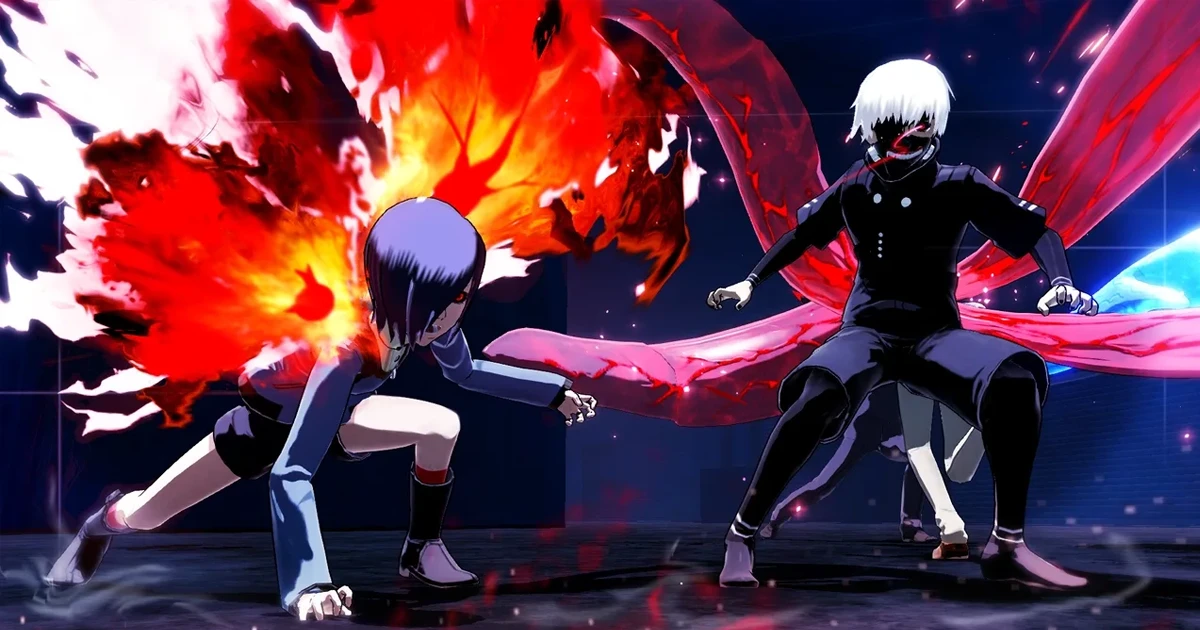
The core combat is fast, bloody, and direct. You move through stages, fight waves of enemies, deal with stronger opponents, and manage your character’s abilities. Ghouls use kagune attacks, while investigators use quinque weapons. This difference helps the two sides feel distinct, even if the systems are not always as deep as they could be.
Combat has a nice sense of weight. Characters do not feel like untouchable superheroes. They feel fragile, sharp, and dangerous. Attacks hit with impact, but health can disappear quickly. You are powerful, but not safe. That is exactly the feeling a Tokyo Ghoul game should have.
The game is also extremely bloody. Blood sprays constantly during combat, giving each fight a harsh visual identity. It is not elegant, but it fits. Tokyo Ghoul is a violent series, and Call to Exist does not soften that. The amount of blood, speed, and aggression gives the game a raw texture that helps it stand apart from cleaner anime action games.
The camera is one of the weaker parts. In tighter spaces, it can become awkward. When enemies crowd around the player, it is not always easy to read the battlefield. Some animations and character models can also behave strangely, which gives the game a rough, mid-budget feeling. It is rarely broken, but it is often untidy.
Still, the combat works better than expected. Dodging, attacking, using special abilities, and cutting through enemies has a satisfying rhythm. In larger encounters, the game can almost feel like a smaller Musou-style brawler, where survival depends on movement and aggression. In one-on-one fights, it becomes more tense, asking for better timing and awareness.
That variety is important. Call to Exist tries to wear many masks. It wants to be a brawler, a survival action game, a shooter, a character-based multiplayer game, and a narrative adaptation. It does not master all of these things, but the attempt gives the game personality.
The shooter elements are functional rather than excellent. They add variety, especially when playing investigator characters, but they do not feel as refined as the melee combat. The parkour and movement systems are also simple. They work well enough for navigating stages, but they are not deep enough to become a major strength.
The multiplayer side gives the package more value. Co-op missions and PvP modes make sense for Tokyo Ghoul because the series is built around faction conflict, team battles, and survival under pressure. The character selection is also better than expected, giving fans a reason to try different playstyles. However, the long-term value of multiplayer depends heavily on whether players can still find others online, so it is difficult to treat it as the main reason to play today.
As a single-player fan experience, though, the game holds up better than its reputation might suggest.
WORLD DESIGN
The world design is simple, dark, and stage-based. Do not expect a full recreation of Tokyo or an open-world interpretation of the series. This is a mission-driven game made from alleys, corridors, industrial spaces, underground areas, and combat arenas.
That sounds limited, but it fits the tone. Tokyo Ghoul has always had a feeling of hidden violence beneath ordinary city life. The game’s environments are not beautiful, but they are bleak and functional. Dark streets and narrow spaces help create a feeling of pressure. You are not exploring a grand fantasy world. You are surviving in corners, tunnels, and battle zones.
The best stages capture the lonely, hostile mood of the source material. When Kaneki or another character is moving through a dark area, surrounded by enemies and blood, the game can briefly feel very close to Tokyo Ghoul’s identity. It has that sense of being hunted and hunting at the same time.
The world design does suffer from repetition. Many areas are plain, and some stages feel more like combat containers than believable places. This is where the budget becomes obvious. The game has atmosphere, but not much environmental richness.
Even so, the design supports the gameplay clearly. Stages are built around movement, enemy waves, and short bursts of tension. It is not elegant, but it is focused.
VISUAL DESIGN
Visually, Tokyo Ghoul Call to Exist is uneven. The character designs are the strongest part, mainly because Tokyo Ghoul already has such memorable visual material to draw from. Kaneki, Amon, Touka, Haise, and other key characters carry a lot of style just by being present.
The attacks also have a strong identity. Kagune effects, weapon strikes, and blood splashes give the combat a harsh visual punch. It is not a technically impressive game, but it often looks intense in motion.
The problem is presentation. The static cutscenes are not especially attractive, and the game can look cheap during story sequences. Character models are serviceable, but not always expressive. Animation quality varies, and some moments can look stiff or awkward.
However, there is a certain charm to it. The game has the feeling of a mid-tier PS2 or early PS3 action title made with modern anime licensing. It is not glossy. It is not cinematic. But it has a strange, rough energy that fits Tokyo Ghoul more than a clean, lifeless adaptation would.
The blood effects also deserve mention. They are excessive, messy, and constant. For some players, this may look crude. For fans of the series, it helps sell the brutality of each encounter.
SOUND & MUSIC
The sound design is functional and supports the combat well. Hits feel sharp, attacks have impact, and the violent rhythm of battle comes through clearly. The game does not have the strongest soundtrack, and it lacks the emotional musical identity that made parts of the anime memorable, but it does enough to support the mood.
Voice work helps the fan experience. Hearing familiar characters in dramatic situations adds weight, even when the story itself is moving too quickly. Like many anime games, the audio often carries more emotion than the visual presentation.
The music is not something I would return to outside the game, but it fits the bleak action tone. It stays in the background, creates tension, and lets the combat take focus.
PERFORMANCE
Performance is mostly acceptable, especially considering the scale and budget of the game. It is not a technically demanding title, and the action generally runs well enough to keep combat responsive.
That said, the game does have rough edges. Camera issues, animation oddities, and occasional visual awkwardness can make it feel less polished. It is not the kind of game where every hit, dodge, and movement feels perfectly tuned. There is a layer of jank that players need to accept.
For me, that roughness did not ruin the experience. In some ways, it adds to the identity of the game. Call to Exist feels like a low-budget anime survival action experiment rather than a safe, polished product. But players who expect modern smoothness may struggle with it.
DIFFICULTY
Difficulty Rating
4 / 10
Tokyo Ghoul Call to Exist is not brutally difficult, but it can be tense. Health can drop quickly, enemies can surround you, and certain battles demand better timing than expected. The game works best when it makes you feel fragile.
That fragility is important. In many anime games, characters feel too powerful. They move through enemies like gods. Here, even strong characters can feel vulnerable. That suits Tokyo Ghoul. The series is built on survival, hunger, fear, and the cost of violence.
The difficulty is not always perfectly balanced. Some encounters feel messy rather than carefully designed. The camera can make fights harder than they need to be, and some enemy waves feel repetitive. But when the game works, it creates a good rhythm of pressure and release.
It is not a mastery-focused action game like Devil May Cry, Ninja Gaiden, or Sekiro. It is simpler than that. But it does ask the player to pay attention, move carefully, and respect danger.
REPLAY VALUE
Replay value depends heavily on how much you like Tokyo Ghoul. For casual players, one campaign playthrough may be enough. For fans, there is more to enjoy.
The different playable characters add variety, and the multiple perspectives give fans a reason to keep going. The lore material is also useful if you enjoy digging into the world. Co-op and PvP modes add extra value, although their usefulness today depends on online activity.
The game is not endlessly replayable, but it offers more content than expected for an anime tie-in. It feels like a compact package made for people who want to spend more time inside this world.
RECOMMENDED FOR
Recommended for:
- Tokyo Ghoul fans
- Players who enjoy anime action games
- Fans of dark, bloody brawlers
- Players who enjoy mid-budget Japanese action titles
Not recommended for:
- Complete newcomers to Tokyo Ghoul
- Players who need polished cinematic storytelling
- Players looking for deep technical action combat
PERSONAL EXPERIENCE
What I appreciated most about Tokyo Ghoul Call to Exist is that it tries. That sounds simple, but it matters.
Many anime games feel safe. They take a popular series, put the characters in arenas, add flashy attacks, and stop there. Call to Exist could have done that. Instead, it tries to build something closer to the feeling of Tokyo Ghoul. It is messy, but it has intent.
The game understands that Tokyo Ghoul is not only about fighting. It is about survival. It is about people who are forced into violence by hunger, loyalty, trauma, or duty. The combat reflects that more than I expected. You feel strong, but not invincible. You spill blood, but you are always close to losing your own.
I also liked that the game includes different sides of the conflict. Playing as both ghouls and investigators helps the world feel less simple. Tokyo Ghoul works best when nobody is fully clean, and the game keeps a little of that moral greyness alive.
It is clearly not perfect. The budget is visible everywhere. The cutscenes are limited. The storytelling is rushed. The camera can be annoying. Some systems feel like they needed more time. But I would rather play a flawed game with a clear soul than a polished game with no identity.
That is where Call to Exist succeeds. It has identity. It is rough, bloody, awkward, and strange. For Tokyo Ghoul, that almost feels right.
FINAL VERDICT
Tokyo Ghoul Call to Exist is a flawed but surprisingly ambitious anime adaptation. It is not the best anime game. It is not the best action game. It is not even the best version of Tokyo Ghoul as a story. But it is a sincere attempt to turn the series into something playable, and that effort deserves credit.
The game struggles with rushed storytelling, cheap presentation, awkward camera work, and obvious budget limits. New players will likely feel lost, and those looking for a polished modern action game may come away disappointed.
But for fans, there is something here. The combat is fast and bloody. The character roster has value. The lore material is appreciated. The tone is closer to the source than expected. Most importantly, the game understands the desperate feeling at the heart of Tokyo Ghoul: the need to survive in a world where every side is wounded.
Tokyo Ghoul Call to Exist is not clean. It is not elegant. It is not fully successful. But it has bite.
For fans of the franchise, it is worth playing. Not because it is perfect, but because it is one of those rare anime tie-in games that actually tries to be more than a product.