
GAME INFORMATION
Game Title: Pragmata
Platform Played: Playstation 5
Available Platforms:Playstation 5
Media Type: Physical Disc
Developer:Capcom
Publisher:Capcom
Genre:Science-fiction action-adventure
Release Year: 2026
PLAY ENVIRONMENT
Playtime:16 hours
Completion Status: Platinumed
Difficulty: Default / Lunatic later on
Graphics Mode: Performance
Playthrough Type:Full campaign, all simulation missions, all collectibles, and post-game content
Game Version: Latest Version
Controller Used: DualSense
Display Environment: 1080p Monitor
QUICK VERDICT
Pragmata is incredible.
It is a focused, confident, and deeply satisfying sci-fi action game built around one brilliant idea: real-time hacking mixed with punchy third-person shooting. The story does not explore every part of its world as deeply as it could, but the bond between Hugh and Diana gives the game a heart that stayed with me long after the credits.
The combat is sharp, the hacking system is genuinely creative, the boss fights are intense, and the final stretch hit me much harder than I expected. I finished the game, completed everything, and still found myself thinking about Hugh and Diana afterwards.
Pragmata is not perfect, but it is special. It reminded me why I love games that take one strong idea and commit to it fully.

PROS & CONS
pros
- Fresh and engaging combat system built around hacking.
- Hacking feels central to every fight, not like a gimmick.
- Shooting feels heavy, satisfying, and purposeful.
- Each weapon has a clear role and encourages active swapping.
- Boss fights are large, intense, and mechanically strong.
- Hugh and Diana’s gameplay partnership is excellent.
- Diana feels like part of the combat system, not just a companion.
- The emotional ending is powerful and memorable.
- Clear pacing, strong mission structure, and a satisfying 15 to 16 hour length.
cons
- The wider sci-fi story could have been explored more deeply.
- Some important Diana details are hidden in data logs.
- Space station environments can feel repetitive.
STORY & NARRATIVE
Pragmata begins with a strong sci-fi setup. Hugh is part of a crew sent to a lunar space station, but when a rogue AI turns the station’s machines against them, he is left as the lone survivor. The Moon is presented as a place built through massive-scale 3D printing, where infrastructure can be recreated faster than it can be properly maintained.
It is a brilliant idea. It immediately gives the world a cold, artificial, and unsettling feeling. This is not a warm vision of the future. It is a place where technology has gone too far, where human life feels small beside systems that can endlessly rebuild themselves.
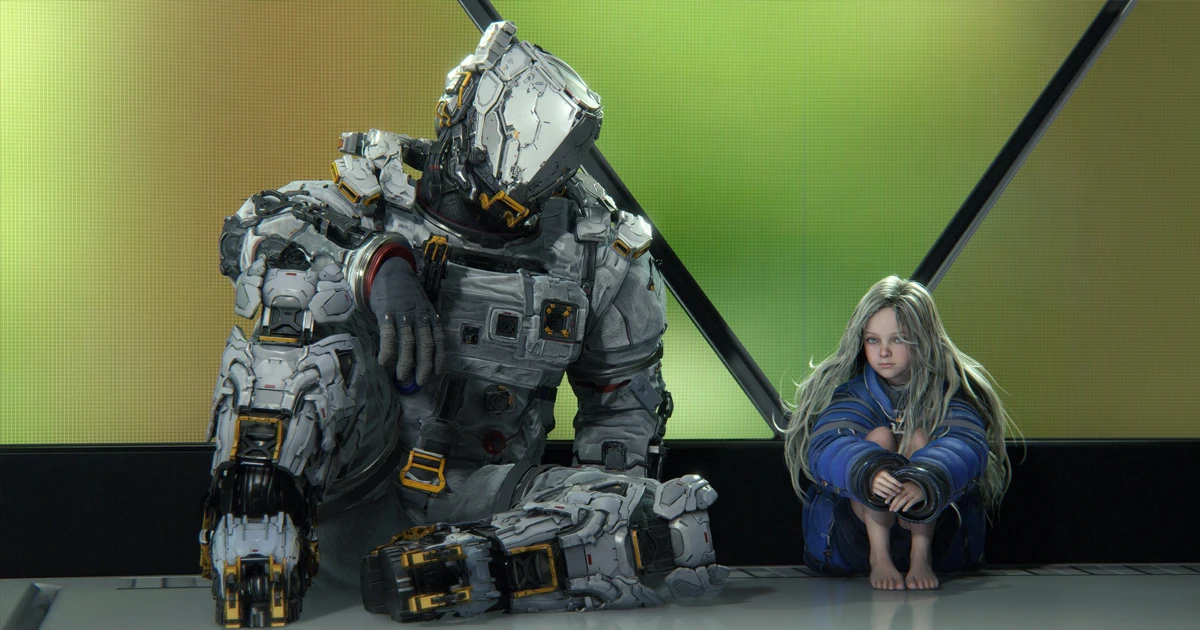
However, Pragmata does not fully explore all of this. The wider sci-fi drama is interesting, but much of it stays in the background. The story becomes more focused on Diana, a humanoid robot girl who becomes Hugh’s companion, partner, and emotional centre of the game.
This is where Pragmata becomes more personal.
The story is familiar in some ways. A rogue AI. A robot girl learning about humanity. A man trying to survive against impossible odds. These ideas are not new, but Pragmata makes them work because of the emotional connection between Hugh and Diana.
Diana’s curiosity about Earth, human objects, drawings, toys, and everyday life gives the game a gentle sadness. When she learns about the world through small objects and quiet conversations, the cold space station starts to feel more human. These moments are simple, but they matter.
The found father-daughter dynamic between Hugh and Diana touched me deeply. It could have used more time to develop in certain areas, and Hugh himself is not always the strongest character, but their relationship still reached me. By the end, I cared about them. I wanted them to survive. I wanted them to find some kind of peace.
And then the ending hurt.
It hurt in the way only a game can hurt when you have spent hours fighting beside someone, protecting them, relying on them, and slowly understanding them. Diana is not just a companion in a cutscene. She is part of every battle. She is part of your survival. Because of that, the emotional weight of the ending landed much harder for me.
Pragmata’s story may not be perfect, but its heart is real.
GAMEPLAY & SYSTEMS
This is where Pragmata truly shines.
The core idea is simple: Hugh shoots, Diana hacks. But in practice, this becomes one of the most exciting combat systems I have played in a long time.
Whenever you aim down sights, hacking happens in real time. You solve a grid-based pathing puzzle while still watching the battlefield, dodging enemies, managing weapons, and keeping pressure on your target. A successful hack exposes weak spots and makes enemies vulnerable to real damage.
This could have become annoying very quickly, but it does not. Instead, it becomes the game’s greatest strength.
The hacking system keeps evolving. Blue spaces can extend enemy vulnerability. Yellow nodes add extra effects, such as spreading hacks to nearby robots, increasing damage, or turning enemies against each other. Tougher enemies and bosses add more complex grids, obstacles, and pressure.
At its best, Pragmata makes your brain work in two places at once. You are reading the battlefield with one eye and solving the hack with the other. It can feel overwhelming, but that is what makes victory satisfying. When a fight seems impossible, the answer is usually not brute force. It is better hacking, smarter positioning, cleaner weapon use, and a calmer mind.
The shooting is also excellent. Landing a direct shot on a hacked weak spot feels heavy and rewarding. The shotgun has impact. The charge rifle feels precise. The grenade launcher is great for crowd control. The stasis net gives you breathing room when everything becomes too much. The automatic rifle is wild, loud, and satisfying once you learn to control its recoil.
Weapon heat management can sometimes be annoying, especially with the pistol and rifle, but it also encourages swapping weapons instead of relying on one option forever. Heavy weapons have limited ammo, so some fights force you to scavenge and adapt in the middle of combat.
The stagger and execution system adds another layer of reward. Building the stagger meter through certain weapons and hacking nodes can lead to powerful finishers with strong visual feedback. It makes difficult fights feel even more satisfying when you finally break through.
Pragmata’s combat is not just fun. It is intelligent. It asks you to stay calm under pressure, solve problems quickly, and use every part of the system.
WORLD DESIGN
Pragmata has fairly linear levels, but they are well structured. The game often moves between tight corridors, exploration sections, and larger combat arenas. This rhythm is predictable, but it works because the combat encounters are strong enough to carry it.
There are also plenty of optional rewards, upgrade resources, collectibles, data logs, holograms, and hidden paths. Exploring the environment feels worthwhile, especially when you return later with new access and collect everything you missed.
I liked that Pragmata has an old-school design feeling. It is not trying to be endless. It is not trying to waste your time. It gives you levels, challenges, bosses, secrets, and reasons to replay. That structure makes it easy to stay focused.
The hideout hub also gives the game a nice pause between missions. Simulation missions offer extra challenges and teach you useful combat techniques. Some of them test your understanding of enemies, weapons, and hacking in creative ways.
The main weakness is repetition. The space station setting is effective, but by the end, I did start to feel worn out by the amount of sterile corridors and similar-looking environments. The world is visually impressive at times, but I wish it had more environmental variety.
Even so, I was still happy to return to earlier areas for collectibles and upgrades. That says a lot about how strong the core game is.
VISUAL DESIGN
Pragmata has a clean, cold, and polished sci-fi look. The lunar space station feels artificial, sterile, and lonely, which fits the story well. The enemy robots are imposing, and the larger boss designs create a strong sense of scale.
Diana’s design is one of the game’s strongest visual elements. She stands out against the harsh environment and gives the world a softer emotional presence. That contrast between cold machinery and fragile humanity is a big part of what makes Pragmata memorable.
The game can look impressive, especially during boss fights, combat effects, and emotional scenes. However, the repeated use of similar space station interiors does make the visual design feel limited at times.
Still, the overall art direction is strong. It knows what kind of atmosphere it wants to create, and it commits to it.
SOUND & MUSIC
The sound design plays a big role in making the combat feel satisfying. Weapons have strong impact, enemy machines sound dangerous, and the feedback from successful hacks, weak spot shots, and executions helps every fight feel clear.
The music supports the sci-fi atmosphere well without overwhelming the experience. It gives the game tension during combat and enough emotional space during quieter moments with Diana.
The voice work also helps sell the relationship between Hugh and Diana. Their dynamic relies on small moments, and those moments would not work if the performances felt flat. Diana especially gives the game a lot of its emotional weight.
PERFORMANCE
Based on my experience, Pragmata ran well and allowed the action to stay readable even during intense fights. This is important because the game asks a lot from the player. You need to watch enemies, aim accurately, manage weapons, and solve hacks at the same time.
A game like this cannot afford to feel unclear or sluggish. Thankfully, the combat remained responsive enough for the hacking and shooting loop to work properly.
DIFFICULTY
Difficulty Rating
6 / 10
Pragmata can be tough. Some encounters throw a lot at you, and the real-time hacking system can become stressful when enemies are closing in from multiple angles. Boss fights are especially demanding because they test both your combat reactions and your ability to solve hacking grids under pressure.
But the difficulty usually feels fair. When I failed, I normally felt like there was a better approach I could take. I could change my weapons, use different nodes, manage space better, or think more carefully about when to hack.
The game rewards patience and improvement. It can break your brain at times, but that is part of what makes it satisfying.
The only difficulty issue comes from movement in some simulation missions. Hugh’s momentum can feel unpredictable, and when the game asks for platforming, it can become frustrating. Thankfully, this is not a major part of the main campaign.
REPLAY VALUE
Pragmata has excellent replay value for players who enjoy mastery.
The main campaign takes around 12 hours, but completing everything took me around 15 to 16 hours. That included all simulation missions, all collectibles, and post-game content. The extra content felt worthwhile because the gameplay stayed enjoyable after the credits.
This is one of the rare games where I naturally wanted to 100% it. I was not forcing myself through a checklist. I wanted more fights, more upgrades, more challenges, and more time with the combat system.
The post-game is also worth seeking out. Without spoiling it, it adds more reasons to keep playing and gives the game some strong final challenges.
RECOMMENDED FOR
Recommended for:
- Players who enjoy creative third-person action games.
- Players who like Capcom’s modern action design.
- Fans of sci-fi stories with emotional character dynamics.
- Players who enjoy tough but fair combat.
- People who like games that are focused, complete, and not too bloated.
- Players who enjoy 100% completion when the gameplay is strong enough to support it.
- Fans of companion stories, especially found family or father-daughter dynamics.
- Players who miss the experimental feeling of older action games.
PERSONAL EXPERIENCE
I loved Pragmata.
I expected to enjoy the combat, but I did not expect the game to affect me as much as it did. At first, I was mainly impressed by the hacking and shooting. It felt fresh, clever, and immediately satisfying. Every fight asked me to focus, adapt, and stay calm.
But over time, Diana became the reason the game stayed with me.
Her role in the gameplay made her feel important from the beginning. She was not just following Hugh around. She was helping me survive. Every hack, every opening, every vulnerable weak spot came through her. That made the emotional bond feel stronger, because I was relying on her constantly.
The quieter moments made that bond even more meaningful. Seeing Diana learn about Earth, human objects, and small pieces of ordinary life gave the game a gentle sadness. She felt innocent, curious, and fragile in a world that was cold and mechanical.
By the end, I was fully attached to her and Hugh as a pair.
The ending crushed my heart. I still feel the pain of it now. It is one of those endings that stays in your chest after the game is over. Even if the story has flaws, even if some details could have been handled better, the emotional impact was real for me.
Pragmata reminded me that a game does not need to be massive to be powerful. Sometimes it just needs a strong idea, a clear identity, and a bond worth caring about.
FINAL VERDICT
Pragmata is a brilliant sci-fi action game with a beautiful emotional core.
Its story could have explored its world more deeply, and some important character details deserved more space in the main narrative. Hugh is also not always the most memorable protagonist by himself. But none of that stopped Pragmata from becoming one of the most satisfying and emotionally powerful games I have played.
The hacking and shooting system is outstanding. It is creative, intense, and rewarding from start to finish. The boss fights are excellent, the pacing is strong, and the game respects your time while still giving completionists a meaningful reason to keep playing.
Most importantly, Hugh and Diana’s bond touched me. Their dynamic gave the game its soul. By the end, Pragmata was no longer just a clever action game about hacking robots on the Moon. It became a story about connection, protection, loss, and the pain of caring for someone in a world that feels too cold for them.
I finished Pragmata at 100%, and I still wanted more.
It is focused. It is emotional. It is beautifully designed. It is painful in the best way.
Pragmata is incredible.